
Missouri State University

Skip to content Skip to navigation
a b c d e f g h i j k l m n o p q r s t u v w x y z

Community Engagement Blog

How we do community engagement at Missouri State

Home » Nutrition

Teaching Kitchens Equip Bear Pantry Members with Cooking Skills

December 8, 2025 by Natalie A. Clayton

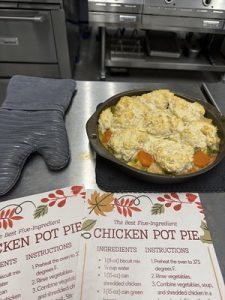
Bear Pantry members make a chicken pot pie.

Exciting things are stirring in the Foods Lab on the top floor of Kampeter.  

Interactive cooking classes, called “teaching kitchens” spark connections between peers and support cooking skills as dietetic graduate students lead hour-long sessions focusing on creating meals from the Bear Pantry. 

Titled “Foodie Fridays”, the idea for this class stemmed from a collaboration between the Bear Pantry and the dietetics department to focus on supporting UN Sustainable Development Goal #2: Zero Hunger. MSU students, faculty, and staff are receiving food from the Bear Pantry but may not know how to cook nutritious, balanced meals with the ingredients. As there was not a resource currently being offered, Stephanie Urich, Clinical Instructor for the School of Health Sciences, and Dr. Alex Johnson, Director of the Center for Community Engagement, decided to fill this gap.  

Over two separate sessions, Monse Velazquez, graduate student in the dietetics program, led fifty Bear Pantry members through the process of cooking a chicken pot pie and a chickpea curry…all from ingredients you can commonly find at food pantries.  
Monse was inspired to focus on canned goods. “Growing up in Paraguay, we didn’t have canned goods like we do here in the U.S… When I moved here, I realized canned goods were very affordable, but I didn’t know how to cook with them, and that was a challenge. Many Bear Pantry members are international students who face this same barrier. Having access to canned goods is helpful, but only if you know what to do with them. I wanted to fill that gap and make pantry foods feel approachable, familiar, and exciting,” notes Monse. 

“Having access to canned goods is helpful, but only if you know what to do with them. I wanted to fill that gap and make pantry foods feel approachable, familiar, and exciting” 

A blend of hands-on cooking experience and nutrition education made up the session. The participants were placed in groups and worked together to create the meal, then Monse led them through creating nutritious, balanced meals with ingredients on hand. 

“One thing I think is really special about this new project is the opportunity it brings our Nutrition & Dietetics students to get real-world, hands-on experience. We’re not just having fun and eating delicious food in the kitchen (although we are doing that!). We’re helping to build food literacy and improve health outcomes in our campus community,” Stephanie remarks. 

Dietetic graduate student Betsy Whitehurst will be continuing the monthly series starting next February. 

That’s not the only way teaching kitchens support the Bear Pantry. 

Dr. Daniela Novotny, Senior Instructor for the School of Health Sciences and her DTN 695 research class led two teaching kitchen sessions focusing on meals from the Bear Pantry in October. With an audience of first-generation college students through the Bears Lead group, the sessions focused on cooking basics, dorm cooking, and snack hacks. Power Bowls with Creamy Avocado Sauce, Bean & Veggie Quesadillas, and Microwave Peach Crisps were all on the menu. 

Being a research class, the group analyzed the data to find that the group felt more confident in the kitchen and built their nutrition knowledge on a statistically significant level.  

Teaching kitchens are showing great promise in supporting the Bear Pantry! 

How to Join Foodie Fridays 

  • You must be a Bear Pantry member to join.  
  • A sign-up form will be emailed to Bear Pantry members in advance. The form will also be posted in the Bear Pantry. 
  • Come and attend a fun cooking session!
  • Spots fill quickly so don’t miss out!  

Filed Under: Nutrition Tagged With: Bear Pantry, cooking class, food and nutrition, Nutrition and Dietetics

Budget Friendly Shopping and Cooking Tips

February 3, 2025 by Samantha G. Selsor


Happy February Bears!

For this month’s blog post, I wanted to focus on some budget friendly shopping (and cooking) tips.

A Dietetic Student’s Top Five Shopping Tips:  

  • Purchase meat in bulk from Sam’s Club or Costco OR meat that is close to expiration 
    • Meat sold in bulk is typically cheaper than purchasing individual packages. For example, a pound of 80/20 (80% lean/20% fat) ground beef from Walmart is $5.86/pound. A pound of 93/7 (93% lean/7% fat) ground beef from Sam’s club is $4.88/pound. The 93/7 ratio is better for you too! While buying meat in bulk is typically more expensive upfront (because you are purchasing more than one package), it is more cost effective overall. Additionally, when you purchase more than one package at a time, it can freeze and last a whole month (if you plan accordingly). 
    • Meat will also be marked down closer to its expiration date at grocery stores like Walmart or Hy-Vee, so you can stock up on  discounted meat and freeze for later use.  
  • Choose frozen fruits and vegetables instead of fresh
    • Nutrition: Frozen fruits and veggies have the same nutrient content as their fresh counterparts. Often, they are picked from the field, processed, and frozen the same day at peak freshness. 
    • Expense: Frozen produce is inexpensive (a Great Value bag of frozen green beans is 98 cents!) and a great way to add a vegetable as a side dish, in a casserole, soups and stews, or fruit to a smoothie or oatmeal.
    • Processing: Frozen produce undergoes minimal processing—most have no additives, preservatives, or seasonings added. This makes them versatile for adding to recipes and more heart healthy (low sodium!). 
    • Expiration: Frozen produce doesn’t expire as quickly as fresh. The worst that could happen is a little freezer burn! This results in less food waste. 
    • Preparation: Most frozen vegetables come in a steamable package, which are easy to throw in the microwave for 4-5 minutes and have perfectly steamed veggies. 
  • Choose store brand instead of name brand
    • Often, name and store brands are the same product, or are produced in the same factory, and just have a different label.  
      • Price difference example: a family sized box of Honey Nut Cheerios is $4.63 and the Great Value equivalent is $2.97. That’s some serious savings!
  • Purchase fresh fruits and vegetables in season (more nutritious and less expensive)
    • Spring: asparagus, avocados, bananas, cruciferous vegetables (broccoli, cabbage), carrots, lemons and limes, and lettuce 
    • Summer: berries (strawberries, blueberries, raspberries, and blackberries), melon (cantaloupe, watermelon, and honeydew), stone fruits (peaches, nectarines, plums), bell peppers, summer squash, tomatoes, zucchini, bananas and avocados, corn, cherries, cucumbers, and green beans  
    • Fall: apples, squash (pumpkin, acorn, spaghetti, butternut), sweet potatoes, potatoes and yams, onions, garlic, ginger, brussel sprouts, and cauliflower  
    • Winter: citrus (clementines, oranges, and grapefruit), pumpkin, winter squash, beets, potatoes and sweet potatoes, and yams
  • Use ready-made/grab-and-go when applicable
    • Steamer rice packets: I like Ben’s Original brand. Ensure these are unseasoned if you are watching sodium intake or food additives. 
    • Steamer potato packets: The Little Potato Co. makes steam packages. These are both convenient and decent serving sizes to decrease food waste. 
    • Individual yogurt cups or yogurt drinks: Chobani Complete drinks are a great option for complete protein that is lactose free. Great Value individual yogurt cups are an easy way to take a high protein snack on the go. Pair with some fruit and granola, nuts, and seeds and you have a satisfying, hunger crushing snack.
    • Cheese sticks or cheese and cracker snacks: Sargento Balanced Breaks are easy options with different cheeses and cracker assortments. (Pro tip: you can also make your own with crackers and blocks of cheese—this takes a little more prep time, but it saves money!) 
    • Pre-chopped fruits and vegetables: Hy-Vee Short Cuts are a great option for pre-chopped fruits and vegetables for those that are short on time, however, these are a bit more expensive. 
    • Seasoning blends: These eliminate the need to buy individual seasonings (which can get expensive). My favorite brands include Siete for tacos, fajitas, etc. or Walmart’s Great Value, which typically have fewer and better ingredients than the name brands. 
    • Rotisserie chickens: A rotisserie chicken is a game changer! They are so versatile and don’t require any cooking. I use these to make chicken noodle soup, quesadillas, casseroles, chicken pot pies, the list goes on… 

A Dietetic Student’s Top Five Cooking Tips: 

1. Plan ahead

At the beginning of each week, plan a few meals that you are comfortable making and know you enjoy. Make a list of all the ingredients you have and need, then shop for groceries. This not only saves you time throughout the week, but also sets you up for success by avoiding take-out and saving money. 

    • Here are a few of my go-to recipes for busy school/work weeks: 
      • Chicken quesadillas  
      • Beef tacos (or taco bowls) 
      • Turkey chili (especially in the fall/winter) and cornbread 
      • Vegetable beef stew and bread 
      • Pasta (so versatile! pesto and chicken or ground turkey and a marinara sauce) 
        • Note: all of these recipes and more are available on Nutrition Corner (available here: https://flic.kr/s/aHBqjBHd3s) 
2. Focus on protein (then carbohydrates, fiber, and healthy fats)

Centering your meals and snacks around protein ensures that you will be creating a balanced, satisfying meal. After you choose a protein, add a carbohydrate (or carbohydrates), fiber, and some healthy fats. 

    • Example meal:  
      • Protein – chicken breasts 
      • Carbohydrates – roasted sweet potatoes cooked in olive oil (healthy fat) and seasoned with salt and pepper 
      • Fiber – black beans 
      • Depending on how the chicken is seasoned, you could make this into a taco bowl and add some sliced avocado and/or shredded cheese and sour cream for some additional fat (and protein!). For the carbohydrate component, you could switch the roasted sweet potato for brown rice, which would also add some additional fiber and whole grains. 
3. Make enough for leftovers
  • A common misconception is that you need to “meal prep” at the beginning of the week to have homecooked meals throughout the week, but you don’t have to spend additional time in the kitchen if you make more for dinners. This takes care of having lunch prepped for school or work—just grab and go!
4. Utilize sheet pans, crock pots, and instant pots
  • There are so many recipes for each of these cooking tools/appliances that make for easy preparation and clean up. (Not as many dishes to clean? Sign me up!) 
5. Cook food thoroughly
  • One of my most used kitchen tools (apart from pots and pans) is my digital thermometer—especially for meat like chicken or beef. Cooking foods thoroughly ensures food safety and mitigates any risk for developing a foodborne illness.  

I hope these shopping and cooking tips are helpful! Whether you are shopping for all your groceries or using the Bear Pantry as a supplemental resource, creating healthy and satisfying meals doesn’t have to be hard!


Don’t forget to follow us on social media!  

Instagram: @mostatebearpantry & @mostatecce  

Like us on Facebook: Bear Pantry   

YouTube: @mostatebearpantry   

LinkTree: https://linktr.ee/bearpantrymsu   

Filed Under: Nutrition, Uncategorized

Categories

Archives

Meta

  • Log in
  • Entries feed
  • Comments feed
  • WordPress.org
  • Accessibility
  • Disclaimer
  • Disclosures
  • Equal Opportunity Employer and Institution
  • © 2026 Board of Governors, Missouri State University
  • Contact Information