
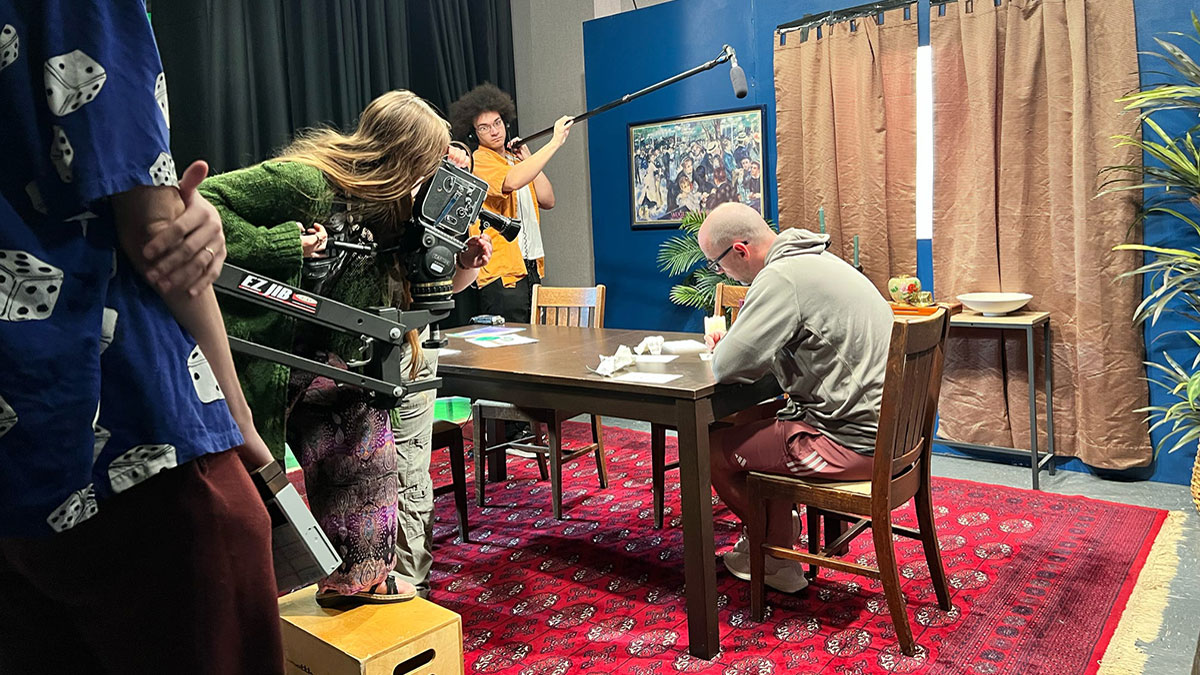
During Missouri State University’s May 2025 intercession, students who enrolled in “The Art and Skill of Shooting Super 16mm Celluloid Film” (Media 300/600) course got a first-hand look at the craft of celluloid filmmaking.
Instructor Conci Nelson, from the Department of Communication, Media, Film and Journalism (CMJF), taught the three-week practicum. The course trained students on how to plan and shoot celluloid footage using two Bolex H16 film cameras.
“The goal of this course is for students to gain an appreciation for the origins of filmmaking and content creation and better understand the utility of thorough planning and economic execution in a production,” Nelson said.
Nelson will incorporate footage that the class created into a short film she is producing, “The Princess of Ildereen.”
Reviving traditional filmmaking
In the fall of 2024, Nelson pitched the idea of a course devoted to celluloid filmmaking to the CMJF department. The class was needed, she said, because current technologies tend to inhibit students’ ability to learn essential filmmaking skills. Moreover, while digital and AI technologies might speed production, they don’t always encourage creativity, she added.
“Many students rely far too heavily on digital technology for focus, [but] what happens when you don’t have access to power?” Nelson asked. “Without power in digital filmmaking, there likely won’t be any shooting happening.” For example, a filmmaker might not have access to important peripheral tools, like Bluetooth monitors and scopes, which are used to represent focus using color or grids.
Instead, Nelson’s course teaches students how to use external light meters, tape measures to calculate focus, manual focus techniques and how to plan a shot. Even understanding the tangible qualities of film, such as its feel and smell or how it sounds when rolling properly, is part of the course.

“Old school” is cool again
Students spent the first part of the course learning camera structure, planning shots, handling film, loading film magazines, changing reels, measuring distance and focus and reading a light meter.
During the remaining weeks of the course, the students built and dressed the set, rehearsed, and shot film. Every student practiced using the camera and working with the camera team, Nelson said.
When graduate student Ashlyn Parker-Smith first used the camera, she said it felt like a dream come true.
“There my name was on the call sheet, next to the words ‘Director of Photography,’” she remembered. “I screenshotted it and sent it to everyone I could. ‘I’m having the time of my life. This is the coolest I’ve ever felt,’ I told them.”
Parker-Smith is a second year graduate student pursuing master’s degrees in religious studies and in dramatic writing. She hopes to eventually earn a doctorate and teach at the collegiate level.

Finding value in “the old ways”
The students appeared eager to learn about classic filmmaking, according to Nelson.
“They all seemed to have an interest in understanding ‘how things used to be’ in filmmaking,” she noted. “What was wonderfully gratifying was that most of them left hoping to be able to work more on film in the future.”
“I had so much fun,” Parker-Smith said. “And there’s a particular kind of fun to be had in doing 16mm filmmaking. The uncertainty and finality compound into a unique and thrilling kind of anticipation.”
Even the historical aspects of film techniques intrigued the students and helped them learn to value “the old ways,” Nelson said. Shooting on film contextualizes how and why certain processes and terminology originated, she added. “This better prepares them to understand the hierarchy present on any set, which is paramount for success.”
According to Nelson, many prominent directors continue to shoot on film. “By giving students the opportunity to work with celluloid, we’re giving them an edge on experience that many graduates of film school from other schools do not receive,” she noted.
Putting the magic back in moviemaking

Inspired by a life-long passion for cameras and filmmaking, Parker-Smith enrolled in Nelson’s class, even though she was a bundle of nerves when she registered. She felt “hindered” by the idea that it just wasn’t possible “for someone like me to make movies.”
Happily, the class exceeded Parker-Smith’s expectations. “There are very few times where I’ve had a class gel like this one did,” she said. “Everyone was totally invested in the work and in gaining knowledge. There were very diverse levels of experience and talents in this group, with a unifying, shared reverence for filmmaking and 16mm film.”
Parker-Smith thrived on what she called the “creative freedom of limitations” that arose during the course. “The film we had was the film we had. A camera broke. It rained. The camera motor lasted only 30 seconds. We will have no idea what our footage looks like until it gets back from the lab. Was the boom mic in frame during the only good take? Who’s to say? And there’s a sort of magic in that.”
CMJF department offers multiple options
The CMJF department isn’t just about film and film studies. It offers a broad range of comprehensive educational opportunities, something Nelson is quite proud of. Students can choose from a variety of career options in several degree paths, including a master’s program, undergraduate degrees, minors and specialty certificates.
“I think if a student has a vested interest in learning how to communicate and navigate in our world in an informed and intelligent manner, our department is the best route,” Nelson said. “Pursuing communication, media, journalism and film can lead to a career in everything from politics to marketing, filmmaking to broadcasting.”

“This class has had an astronomical impact on my career prospects,” Parker-Smith said. “By the end of the course, I decided to apply for the MFA program (in dramatic writing). I have Conci Nelson and this class to thank for this decision.”
“I am thrilled by the prospect of achieving this dream at the conclusion of my time at Missouri State.”
Photos provided by Conci Nelson and Ashlyn Parker-Smith.
Discover more from Reynolds College Blog
Subscribe to get the latest posts sent to your email.