
The online encyclopedia Britannica defines the humanities as “those branches of knowledge that concern themselves with human beings and their culture.”
In the 21st century, digital technology now dominates all fields and professions, including the humanities. As a result, the field of digital humanities (DH) has emerged as an innovative approach to blending the two.
“There’s a lot of scholarship on what digital humanities is and isn’t,” said Assistant Professor Leah Washburn. “Ultimately, I think it is an area that acknowledges technology as an asset to fields that are often associated with older scholastic traditions.”
One of the most attractive features of DH is its ability to foster interdisciplinary research and teaching, according to Washburn.
“At its core, digital humanities celebrates an interdisciplinary turn in the humanities,” she said. “It invites exploration and inquiry across multiple platforms, fields and subjects in a way that highlights connections between knowledge bases.”
Technology aids preservation and accessibility goals
According to Associate Professor Julia Troche, DH represents both a field of study and a practice. The process makes the humanities visible through digital methods and also allows scholars to conduct their research using digital methods, she said.
“Examples vary in form, complexity and technological integration,” Troche said. A typical example, she noted, would be a research project culminating in the development of a website or app.
“Research-driven DH might include coding every Shakespearean play and employing statistical analysis,” she added.
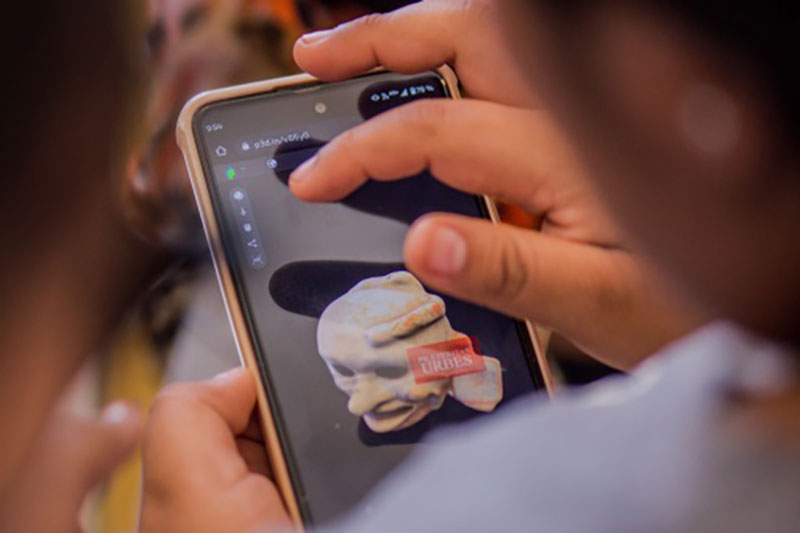
Museums and archaeological projects, where the preservation and accessibility of artifacts is paramount, often use DH. Museums create 3D models of their artifacts, she explained. Scholars and practitioners can then download and use these models in Virtual Reality/Augmented Reality environments.
As an example, Troche cited her own research and teaching project, the Ancient Worlds Study Collection (AWSC). The project has already received hundreds of donated books, and includes a collection of about 50 ancient coins.
Currently, the project has two interns, Hadley Hicks and Lucy Arras. Both are assisting Troche with archiving, cataloging and digitizing the print materials and the ancient coins.
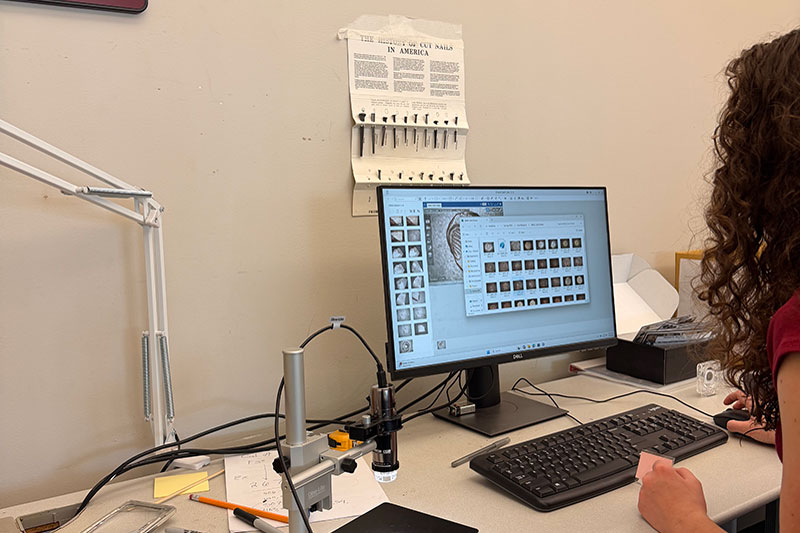
“The coins are first photographed using a microscope,” Troche explained. Together, Troche and Arras will evaluate the coins for other DH visualization techniques, such as reflectance transformation imaging or 3D scanning.
Troche’s research presents opportunities for interdisciplinary collaboration across the university.
“I hope to reach out to our colleagues in material science in the future, as well to conduct a series of XRF tests on the coins to determine their makeup,” Troche said. This process could potentially identify the coins’ origins, as well as the workshops where they were made.
Fostering international collaboration
Like Troche, Dr. John Chuchiak, distinguished professor of history and director of the Honors College, has embraced DH methods successfully. In his case, his team collaborated with international scholars and professionals to develop an award-winning museum exhibit.
Chuchiak works with the international research group “Praeteritas Urbes.” Together, they focus on digital reconstruction and analysis of past urban spaces and historical events.
“Through 3D modeling, spatial analysis and immersive environments, [we] explore how digital reconstructions can function not simply as illustration,” he said. They use the technologies as a research method to test hypotheses about urban development, social interaction, architecture and historical processes.
In 2024, their project, “Ídolos, Persistencias y Resistencias” (Idols, Persistences and Resistences), won the Miguel Covarrubias Award for the best museum exhibit in all the museums of Mexico. The team employed DH methods to create a mixed medium archaeological and virtual simulation exhibit in Mexico. They have since created museum exhibits in Guatemala and Mexico, as well as created educational modules for uses in classes of architecture and Mexican history.
Chuchiak is now working to elevate DH into a graduate certificate at Missouri State. “This is a new and growing field, which includes a wide range of approaches,” Chuchiak noted.
His long-term vision is to create an interdisciplinary Master’s degree and possibly a doctoral degree.
“[This] would be a niche program that is not offered by many universities in our region, or anywhere really,” he said.
Visit the Digital Humanities Lab @ Mo State
Photos provided by John Chuchiak and Julia Troche.
Reynolds College blog posts are human researched, written and reviewed unless otherwise indicated.
Discover more from Reynolds College Blog
Subscribe to get the latest posts sent to your email.