

Students who take Dr. Amy Artman’s Religion and Healing course (REL 378) can expect her to ask a lot of questions.
Artman even starts her course syllabus with questions.
“What does it mean to be healed? How do we cure?” she asks. “Can I be healed without being cured? Cured without being healed? What role does religion play in healing? Does religion have a place in healing?”
She concludes by stating, “These are only a very few of the many questions we will explore together this semester.”
Right away, students understand that Artman will journey with them as they explore the relationships between religion, health and healing. Specifically, students will look at the complex histories of biomedicine, faith and folk healing in twentieth century America up to the present.
Grant-funded course examines role of faith in medicine
Artman first taught REL 378 in 2020. Now a regular offering in the Department of Languages, Cultures and Religions (LCR) curriculum, the class was originally part of a suite of courses developed through a grant. That grant was funded by the Wabash Center for Teaching and Learning in Theology and Religion, Artman said.
Coordinated by Dr. Stephen Berkwitz, Dr. John Schmalzbauer and Dr. Philippa Koch, the grant supported research and course development for the Medical Humanities certificate. Berkwitz, Schmalzbauer and Koch all teach in LCR, and Berkwitz also serves as department head.
Today, introducing students to the debate about whether biomedicine should include a spiritual component remains an important learning objective in the course.
“In recent years, the idea that medical healing should include a spiritual component had basically won,” she noted. “But post-Covid, and as I teach the course in 2026, this discussion is now a live one again, I believe, if in a different way.”
Her goal is not to revive the debate but rather to give students a historical overview of the question and how it has been examined over time.
Course assignments encourage student engagement
Artman invites students to pursue a critical study of religion. “Being critical does not mean finding fault in this context,” she explains. Rather, it means “exercising or involving careful judgment or judicious evaluation.”

Based on that observation, Artman constructs assignments that continually encourage students to engage with course materials to determine what they think and why.
For one assignment, Artman has students reflect on their perceptions of religion and healing at the beginning of the semester. They then revisit that same topic at the end of the semester, reviewing and exploring what they have learned and how those perceptions might have changed.
Other assignments include mid-term and final assessments and a group project. The group project consists of a preliminary development task and then a class presentation.
“The religious studies faculty made an intentional decision a few years ago to increase our opportunities for experiential learning,” Artman said. “I moved to presentations and projects in some classes to give students the ability to seek out experiential opportunities. The presentations are done in teams of two, and we always learn a great deal from each other.”
Class structure blends lectures, discussions and activities
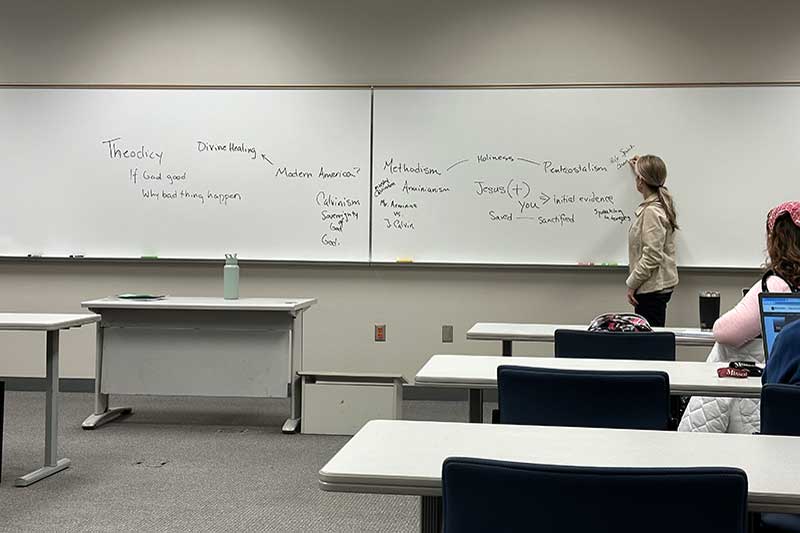
The everyday component of REL 378 is built around in-depth discussions. To accomplish this, Artman devotes the first part of each week to lectures or course material reviews, explaining terms and concepts and answering questions. These sessions establish frameworks for that week’s topics and conversations.
The second part of the week is reserved for discussions. During these discussions, Artman said she expects students to contribute by drawing from their work with that week’s materials.
Senior Casey Williamson, a psychology and sociology double major, appreciates Artman’s teaching style. “She encourages a learning atmosphere different than textbooks and memorization classes,” she said.
Williamson graduates in May and hopes to become a family, marriage and couples therapist. She enrolled in Artman’s class because its content supplemented her career goals.
“I wanted to broaden my horizons on health and community, since these are two concepts that brought me to my career aspirations,” she explained. “I recently explored the ageing process and how that affects mental and physical health. This later introduced the idea of healing and religion to me, which helped me find this class.”
Students thrive from “fresh way of teaching”
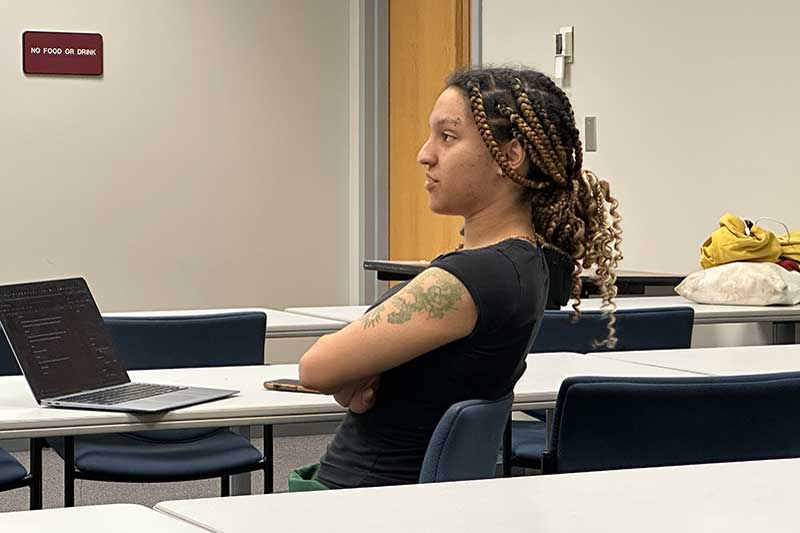
Like Williamson, sophomore religious studies major Mason Oliver appreciates Artman’s classroom methods.
“Dr. Artman has brought a fresh way of teaching that relies not on sitting and copying platitudes onto paper but on constant, active discussion,” Oliver said. “Everybody talks because everybody feels encouraged to talk, and nobody feels the weight of judgment.”
Oliver hopes to teach religious studies with an emphasis on Judaism and antisemitism. He enrolled in the class because he thought the topic sound intriguing. “I am always finding myself wanting to learn more about the faith healers and other things along those lines,” he said.

Religion classes ideal for teaching “soft skills”
Religion courses, Artman believes, can complement any major, minor or certificate. And the LCR department prides itself on offering a variety of classes that emphasize the “soft skills” that are in such high demand.
“Employers increasingly look for soft skills, such as effective communication, clear and creative writing, and the ability to problem-solve,” she said. Religion classes address all of these points.
They are also “spot-on” for Missouri State’s cultural competence pillar, Artman argues.
“Anywhere you work in the future, you will need to be able to communicate across cultures, to understand other people and their approaches to themselves and the world around them,” she noted. “This is what we do in religious studies. This is our specialty. Any career will benefit from a grounding in the soft skills and cultural competence religion classes provide. Plus, our classes are fun and extremely interesting!”
Photo credits: Lynn Lansdown
Reynolds College blog posts are human researched, written and reviewed unless otherwise indicated.
Discover more from Reynolds College Blog
Subscribe to get the latest posts sent to your email.