
Students who take Dr. Amy Artman’s Religion and Healing course (REL 378) can expect her to ask a lot of questions.
Artman even starts her course syllabus with questions.
“What does it mean to be healed? How do we cure?” she asks. “Can I be healed without being cured? Cured without being healed? What role does religion play in healing? Does religion have a place in healing?”
She concludes by stating, “These are only a very few of the many questions we will explore together this semester.”
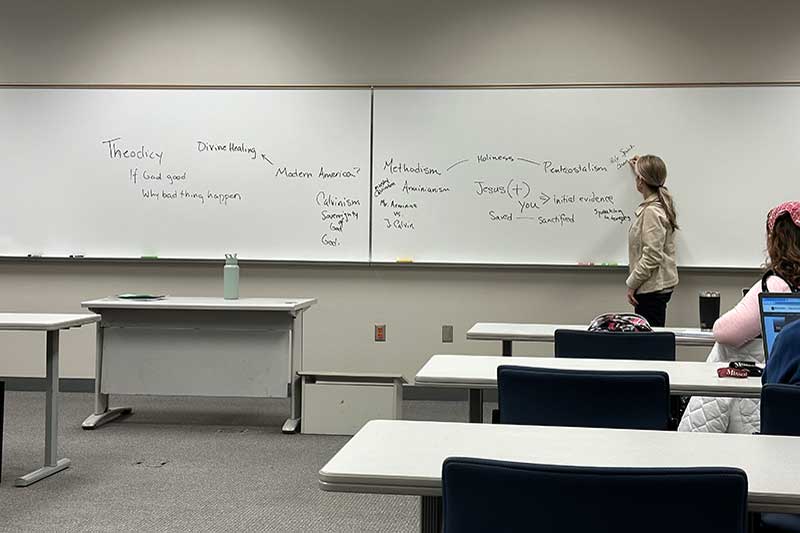
Right away, students understand that Artman will journey with them as they explore the relationships between religion, health and healing. Specifically, students will look at the complex histories of biomedicine, faith and folk healing in twentieth century America up to the present.
Grant-funded course examines role of faith in medicine
Artman first taught REL 378 in 2020. Now a regular offering in the Department of Languages, Cultures and Religions (LCR) curriculum, the class was originally part of a suite of courses developed through a grant. That grant was funded by the Wabash Center for Teaching and Learning in Theology and Religion, Artman said.
Coordinated by Dr. Stephen Berkwitz, Dr. John Schmalzbauer and Dr. Philippa Koch, the grant supported research and course development for the Medical Humanities certificate. Berkwitz, Schmalzbauer and Koch all teach in LCR, and Berkwitz also serves as department head.
Today, introducing students to the debate about whether biomedicine should include a spiritual component remains an important learning objective in the course.
“In recent years, the idea that medical healing should include a spiritual component had basically won,” she noted. “But post-Covid, and as I teach the course in 2026, this discussion is now a live one again, I believe, if in a different way.”
Her goal is not to revive the debate but rather to give students a historical overview of the question and how it has been examined over time.
[Read more…] about Religion and Healing course emphasizes critical thinking