

When communication majors began enrolling for Spring 2026 classes, they encountered a new offering: Environmental Communication. Structured as a second block online class, this was the first time Environmental Communication had been offered as part of the communication studies curricula.
The course is another choice within the fully online option of the communication studies program, according to Senior Instructor Jay Howard. Its purpose is to help students understand the role of communication in negotiating the relationship between people and the environment.
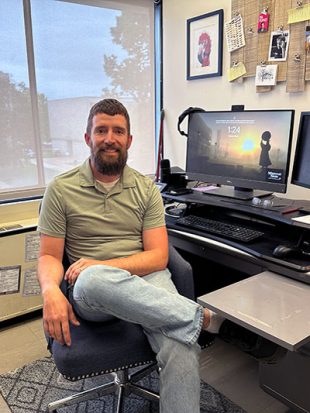
Howard, who teaches in the Department of Communication, Media, Journalism and Film, created the class as a special topics course. He was thrilled when 29 students enrolled, a number just a bit over the class limit.
Most of the students were upper level communications majors, Howard said. “But we did have people from other majors as well find their way into the class, which I was happy to see. And if I get to teach the class again, I’d love to continue to expand and have people enrolled from all across the university.”
Consumers of environmental messaging
Throughout the course, Howard stressed to students how all members of a society are “consumers” of environmental communication. While not everyone will become a public official or climate activist, he noted, people engage in and consume environmental communication daily.
“We need to be able to critically evaluate [this communication] and have some tools for knowing whether the messaging coming at us is accurate or not,” Howard said. “See what they’re trying to get us to do, and why, and whose agenda is being served.”
Because environmental issues tend to affect entire communities and societies, not just individuals, the topic itself can have a wide reach and impact.
“It’s big, it crosses boundaries, has all kinds of stakeholders that all have to cooperate,” Howard said. “There’s a collective action problem. And when you’re trying to coordinate action, you have to use communication.”
Practicing audience analysis in communication
One assignment both Howard and his students found illuminating was the Global Warming’s Six Americas assignment. Howard asked students to complete a short questionnaire based on research from Yale’s Center for Environmental Communication. The survey locates participants in one of six “attitude” segments regarding climate change. The categories range from alarmed and concerned to cautious and disengaged, and doubtful and dismissive.
The goal of the assignment was to help students practice and understand the communication concept of audience analysis.
“Before we can construct an effective message, we have to know who we’re talking to, what they think,” Howard explained. “I wanted the students to get a sense of what the American public was thinking and where they themselves personally fit in the broader context.”
“Although the students ranged widely, as you would expect, in terms of what kinds of actions were reasonable or necessary, I certainly didn’t require anyone to think any particular way,” Howard continued. “This was a good assignment because it helped people see the diversity of opinion.”
Assignments apply learning to real-life messaging
In another assignment, Howard asked students to select a piece of media and apply various audience analysis techniques.
“Usually, it was a website or a specific page on a website of an organization,” he said. “I asked them to familiarize themselves with the content and then, using the methods that we had learned about, to analyze the discourse.”
Discourse, Howard explained, embodies a list of keywords and phrases that are particular to the community or group that’s speaking. “And so you could bring up any transcript of a person’s speech, for example, and say, what words do they keep returning to over and over?” he explained. “What are the key themes? And how do they differ from the themes of someone who might be coming from another perspective?”
“Just getting people to think about those things helps us to be more critical consumers of messages instead of just taking everything at face value that is sort of sold to us from all of these websites.”
Challenges or “super wicked problems?”
An important student learning outcome for the class was to learn to identify environmental challenges communities face and the role of communication in resolving those challenges.
“For example, one of the things we explored was framing environmental issues like climate change as a ‘super wicked problem,’” Howard said.
“Some people who are environmental activists say we shouldn’t frame [issues like] global warming as a ‘super wicked problem’ to begin with, because it paints too bleak a picture,” he continued. “And if we engage in what they call ‘doomerism,’ then that can be actually demotivating, because a super wicked problem is sort of by definition unsolvable.”
“Disruptive communication”
Meanwhile, after reading the students’ end-of-semester reflections, Howard noted that the topic of “disruptive communication” generated a particularly positive response.
“Disruptive communication is when you try to sort of jar audiences out of ‘business as usual’ to get people to think about something they would rather ignore, or look at something in a different way than they’re used to looking at it,” he explained. “It often evokes negative emotions, depending on how people do it.”
As an example, Howard described how protest tactics like blocking highways often backfires, causing people to have a lower opinion of the issue than they did before.
“So my goal in the module was to expose students to all these different types of protest methods that activist organizations use, and then look at whether they work or not,” he said. “And if they don’t work, why not? What do people do that’s more effective?”
To illustrate, Howard had students view videos of protestors who threw tomato soup on famous pieces of art like the Mona Lisa. Some protestors even superglued their hands to artworks and then read their manifestos.
“We looked at videos of some of their performances and videos of the soup protesters, and then I just let the students weigh in,” Howard said. “What did they think? What was more effective and why? And so when students signed up for an environmental communication class, I don’t know if that’s what they thought we were going to be talking about, but it just got them thinking about things in a different way.”
Course embodies public affairs mission
Because Missouri State’s public affairs mission is “multi-pronged,” Howard found the Environmental Communication class addresses several of the mission’s goals.
“When you discuss policies and environmental impacts, you’re practicing how to think about the public consequences of private action,” Howard said. “[This] is what public affairs is all about, thinking through the public consequences of communication.”
This in turn, Howard said, is “key” to ethical leadership. Likewise, environmental communication is inherently public facing, he noted. “It’s about informing, persuading, and mobilizing people. So that connects to the public affairs mission through community engagement.”
Relevance across multiple disciplines
In addition to reflecting the university’s public affairs mission, the Environmental Communication course addresses topics and issues that are relevant to multiple disciplines. From sociology to business to agriculture, Howard hopes the class can meet the needs of students from several academic areas.
“I have hopes maybe that someday a course like this could become a permanent offering,” he said. “Across the university, people have electives that they need. Other programs may be interested in allowing this class to be among the offerings that count toward those various programs,” he added.
Study communication @ Mo State
Photo credits: Lynn Lansdown
Reynolds College blog posts are human researched, written and reviewed unless otherwise indicated.
Discover more from Reynolds College Blog
Subscribe to get the latest posts sent to your email.