Missouri State University

Skip to content Skip to navigation
a b c d e f g h i j k l m n o p q r s t u v w x y z

Health and Human Services News

  • McQueary College of Health and Human Services

Optimizing the health of female athletes

March 24, 2025 by Sewly Khatun

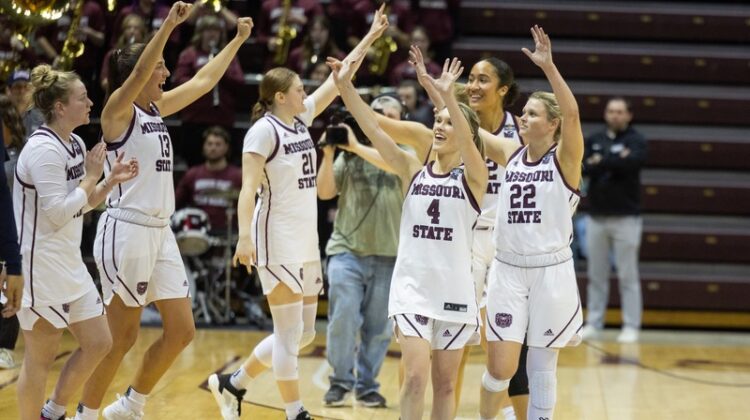
Missouri State University Lady Bears basketball players.

For athletes, staying healthy is crucial to remain competitive.  

Many female athletes, however, face an increased risk of stress fractures due to a combination of physiological, hormonal and nutritional factors. This can lead to missed time from competition. 

To address this issue, an interdisciplinary research team from Missouri State University and North Central College conducted a study assessing the effectiveness of early identification and intervention strategies. By using early screening for energy deficiencies, the goal was to reduce stress fractures and the time lost from sports among collegiate female athletes. 

Missouri State has 15 female teams and 269 female athletes, making this research especially relevant to the university’s athletics program.

Natalie Allen headshot.
Natalie Allen

“Our beginning is a fun story. Back in 2017, at a Missouri State athletics holiday party, we found ourselves in a conversation that took an unexpected turn. As health care providers, we got to talking — what if we teamed up to support student-athletes in a whole new way? One idea led to another and our research team was born,” said registered dietitian Natalie Allen, clinical associate professor of nutrition and dietetics in the School of Health Sciences.  

“One common concern that emerged from our discussion was stress fractures in female collegiate athletes and the Female Athlete Triad.” 

A condition that affects female athletes, the Female Athlete Triad involves three main issues: low energy availability, menstrual dysfunction and low bone density.

The study began in 2018 but faced delays due to COVID-19. The team persisted and published the research findings in the Internet Journal of Allied Health Sciences and Practice this January. The paper is titled “Strategies for Optimizing Female Athlete Health: A Multidisciplinary Approach to Mitigate Stress Fractures and Minimize Missed Participation in Collegiate Sports.” 

Besides Allen, who also serves as team dietitian for Missouri State athletes, the research team comprised:

  • Dr. Melissa Penkalski, associate professor and graduate program director in the School of Nursing 
  • Shannon Hauschildt, associate professor and program director in the department of physician assistant studies 
  • Dr. Kristin Ann Patel, associate professor and program director of health science at North Central College 

Combining their expertise, the researchers identified health gaps in female athletes and developed evidence-based interventions for improved outcomes. 

Research specifics and findings
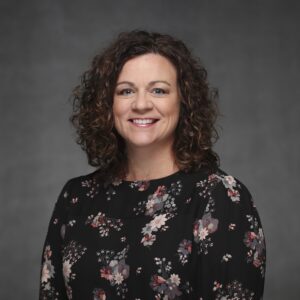
Shannon Hauschildt
Shannon Hauschildt

The study involved 234 female athletes across nine Missouri State teams. To identify those who were at risk for low energy availability and related conditions, they underwent pre-season physicals. The physicals included screening using a tool called the Female Athlete Triad Cumulative Risk Assessment (FACTRA). 

Athletes with a FACTRA score greater than one received nutrition education and consultation from the team dietitian. Athletes were also referred to doctors, athletic trainers and psychologists as needed. 

Before implementing the screening, Missouri State recorded 18 stress fractures among female athletes. This resulted in 848 missed participation days. After early detection and intervention, stress fractures fell to one and missed participation days dropped to 50 — a 95% and 94.6% reduction, respectively.  

The athletes also showed marked improvement in their knowledge and understanding of nutrition risks. 

“This research showed how screening and intervention can keep athletes competing instead of recovering,” Hauschildt said. 

Patel added, “Success comes from a strong multidisciplinary team approach, where coaches and health care providers also work together to support athletes.”  

Power of prevention
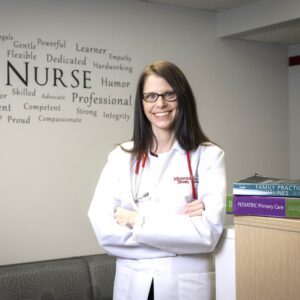
Dr. Melissa Penkalski

One key aspect of the study was the role of nutrition education. At-risk female athletes received targeted dietary guidance, helping them optimize their energy availability and overall health.  

“FACTRA screening is now a standard for pre-participation physicals at Missouri State, setting a model for female athlete health nationwide,” Allen said. 

As a pediatric nurse practitioner, Penkalski notes she sees firsthand how early intervention shapes long-term health.  

“This research empowers athletes to take charge of their well-being, both on and off the field.” 

But there is more to explore.  

The next steps include refining screening tools and investigating new areas, such as iron deficiency in endurance athletes and the impact of Relative Energy Deficiency in Sports on both men and women. 
Read the published article

Filed Under: MCHHS News, School of Nursing Tagged With: Natalie Allen, Nutrition and Dietetics, Physician Assistant Studies, Public health and sports medicine, research, School of Health Sciences

An inside look into MSU’s Cadaveric Anatomy Lab

February 21, 2025 by Sewly Khatun

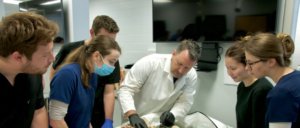
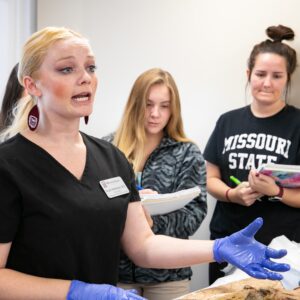
Nicole Gorley (center) demonstrates a cadaver dissection.

The graduate human anatomy lab located in Room 201 in the McQueary Family Health Sciences Hall allows health sciences students to explore the human body through hands-on learning.  

Undergraduate students take their human anatomy lab class in Ann Kampeter Health Sciences Hall, Rooms 369 and 371. 

These labs are where textbook knowledge turns into real-life discoveries. 

Learning anatomy through cadaver dissection

Dr. Patrick Brooks shows students how to dissect a cadaver.

Unlike traditional classrooms, the Cadaver Lab allows direct engagement with human anatomy. 

“For over 400 years, hands-on dissection has been the gold standard for learning anatomy. Seeing, touching and manipulating human bodies provide an unparalleled opportunity no lecture or computer model can replicate,” said Dr. Patrick Brooks, assistant professor in the School of Health Sciences. 

Every session in the lab reminds students of the responsibility that comes with a career in health care. 

“Mistakes happen; it’s part of learning,” said Nicole Gorley, senior instructor in the School of Health Sciences.  

She encourages students to take charge of dissections, helping them build confidence with every step. 

Honoring human donors 

Students learn that working with cadavers is more than an educational experience — it is a privilege requiring respect and responsibility. The generosity of human donors allows future health professionals to put lessons into practice from the classroom. 

“These individuals chose to donate their bodies for science,” said Claire Sextro, a physician assistant studies graduate student. “Their last wish was to help us learn. We don’t take that lightly.” 

Missouri State upholds strict ethical guidelines to honor each donor. Photography and video recordings are prohibited inside the labs. A cadaver’s face and external genitalia remain covered until it is necessary for study.  

Washington University in St. Louis supplies the cadavers through a donation program. A properly preserved cadaver can be used for 12-18 months.  

Since graduate-level dissections are intensive, it requires new cadavers each semester. Once dissections are completed, cadavers are respectfully returned to St. Louis for cremation. 

“I didn’t realize how much hands-on dissection would enhance my learning,” said Zoe Davis, a physician assistant studies graduate student. “Seeing real human structures brought lectures to life — it just clicked.” 

Gateway to medical practice 

Nicole Gorley assists students in an anatomy lab class.

The Cadaver Lab serves as a training ground for students in physician assistant studies, physical therapy, nursing, biomedical sciences and occupational therapy programs.  

“Anatomy education requires highly skilled faculty, yet there’s a national shortage of experts in cadaveric dissection,” said Brooks. “Students overwhelmingly prefer cadaveric dissection over other teaching methods for learning advanced human anatomy.” 

Brooks’ publication, “The Status of Cadaver-Based Anatomy Instruction in Missouri Medical Schools,” underscores the vital role of cadaveric dissection in medical education. 

Beyond technical training, hands-on cadaver dissection builds confidence and enhances decision-making. It also strengthens problem-solving skills and lays a strong foundation for clinical rotations. 

The graduate lab accommodates around 54 students. It is equipped with anatomical models, plastinated structures, preserved organs and digital resources like 3D anatomy tools and imaging technology. 

These resources help students enhance their hands-on dissection experience with various study methods for a comprehensive understanding of human anatomy.

Explore the School of Health Sciences

Filed Under: MCHHS News Tagged With: Nicole Gorley, Patrick Brooks, Physician Assistant Studies, School of Health Sciences

Faculty spotlight: Crystal Powell and Stacy Johnson

February 14, 2025 by Ella Reuter

Exterior of Ann Kampeter Health Sciences Hall.

Our featured McQueary College of Health and Human Services (MCHHS) faculty members are Crystal Powell, assistant professor in the School of Health Care Professions, and Stacy Johnson, clinical instructor in the School of Mental Health and Behavioral Sciences.

Let’s find out more about them.

Where are you originally from?

Powell: Savannah, Missouri.

Johnson: I’m originally from Mountain Home, Arkansas, a charming town about a two-hour drive from Springfield.

What brought you to Missouri State University and how long have you been here?

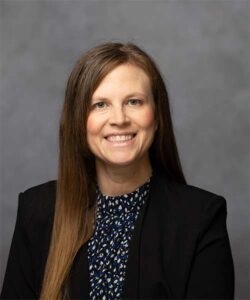
Crystal Powell
Crystal Powell

Powell: I graduated from Missouri State’s physician assistant (PA) program in 2005 and practiced clinically in the Springfield area for many years. During that time, I served as a clinical preceptor for PA students, which sparked my interest in teaching. That spark eventually led me back to Missouri State, where I now have the privilege of teaching in the same program that shaped my career. Since joining the physician assistant studies (PAS) faculty in 2023, I’ve truly enjoyed my time here — it feels like coming home!

Johnson: This is my second year as a faculty member at Missouri State. Joining Missouri State has been a dream of mine because I love mentoring students and helping them understand the transformative impact social workers can have in the field.

What’s your favorite part about working at Missouri State so far?

Powell: My favorite part has been the students. Their energy and passion for learning is truly inspiring — and contagious! They make every day unique and fulfilling and I feel incredibly fortunate to work with such a remarkable group of individuals.

Johnson: What I enjoy most about working at Missouri State is the opportunity to collaborate with professionals from diverse disciplines. The university fosters a supportive culture that emphasizes a healthy work-life balance, which I truly value.

What’s your educational background?

Powell: I received my Master of Science in Physician Assistant Studies from Missouri State in 2005 and my Bachelor of Science in Exercise Science from Brigham Young University in 2002. in 2002.

Johnson: I’m proud to be an alum of Missouri State, where I earned both my undergraduate and graduate degrees in social work.

Why did you choose your career path?

Stacy Johnson
Stacy Johnson

Powell: I became a PA because of my love of science, my love of people and my desire to help others. A PA career allowed me to combine all these interests, and I truly enjoyed my time in clinical practice. Now that I’m here at Missouri State, I have the privilege of guiding PA students as they grow into compassionate and skilled professionals — an experience that’s just as rewarding.

Johnson: I chose social work because I saw first-hand the gaps individuals faced in receiving health services and support. My grandmother’s experiences particularly shaped my perspective, as I witnessed the challenges she faced in accessing the care she needed. Seeing her struggle, and the impact it had on our family, reinforced my belief in the need for better advocacy, support systems and access to services. I’ve always been intrinsically motivated to help people, but I also recognize that by helping others, I find a sense of purpose in myself. Social work allows me to bridge those gaps while fulfilling my own drive to make a meaningful difference.

Where did you work prior to Missouri State?

Powell: Before joining Missouri State, I spent about one and a half years working with Drury University’s PA program. Prior to Drury, I practiced clinically in pediatrics and family medicine for about 17 years.

Johnson: I bring an eclectic professional background to my role, having worked in the medical field, as a therapist specializing in school-aged children and most recently, as a school social worker.

What do you do in your role at the university?

Powell: I’m an instructor in a variety of PAS courses including clinical assessment, clinical medicine, clinical problem solving and procedures. I also serve as the director of assessment for our program.

Johnson: I serve as an instructor for both the Bachelor of Social Work (BSW) and Master of Social Work programs. I also work as an advisor and am the faculty advisor for the BSW Social Work Club.

What’s your favorite thing about the winter season?

Powell: I’m not a huge fan of winter, so to me, the best part of this season is knowing that spring is just around the corner.

Johnson: While I typically prefer spring and summer, I treasure the magic of the winter season, especially with my young children. Watching their excitement makes the season truly special. I also enjoy baking, and winter always feels like the perfect time to whip up something delicious.

Explore MCHHS

Filed Under: Physician Assistant Tagged With: Crystal Powell, Physician Assistant Studies, School of Health Care Professions, School of Mental Health and Behavioral Sciences, Social Work, Stacy Johnson

Celebrating rising stars in health care

December 17, 2024 by Sewly Khatun

Fall 2024 Graduate Celebrations

The McQueary College of Health and Human Services (MCHHS) proudly celebrates students’ achievements.  

A total of 167 students were hooded, pinned and received a white coat within a department or school ceremony for the fall 2024 semester. 

“These culminating ceremonies provide opportunities for faculty and staff to celebrate the academic milestones of students,” said Dr. Letitia White Minnis, MCHHS associate dean.  

Students who have been hooded or pinned are on track to graduate this fall, while those who received white coats are ready to advance to their clinical rotations. 

Occupational Therapy (OT)

Twenty-two Master of OT students were hooded. 

Nursing

Forty-five Bachelor of Science in Nursing students were pinned. 

Speech-Language Pathology (SLP)

Twenty-six SLP students were pinned. 

Physician Assistant Studies (PAS)

Thirty-three PAS students received white coats, while another cohort of 30 students graduated. 

Doctor of Nurse Anesthesia Practice (DNAP)

Eleven DNAP CRNA (Certified Registered Nurse Anesthetist) students celebrated their program completion at a graduation ceremony. 

MCHHS congratulates these emerging health care leaders and is committed to supporting them as they embark on their professional journeys. They play a vital role in strengthening communities and advancing the health care sector. 

 Explore MCHHS programs

Filed Under: MCHHS Events, MCHHS News, Occupational Therapy Tagged With: commencement, Letitia White-Minnis, Physician Assistant Studies, School of Nursing, speech-language pathology, Student Success, students

« Previous Page
Next Page »

Categories

Archives

Meta

  • Log in
  • Entries feed
  • Comments feed
  • WordPress.org
  • Accessibility
  • Disclaimer
  • Disclosures
  • Equal Opportunity Employer and Institution
  • © 2026 Board of Governors, Missouri State University
  • Contact Information


Loading Comments...