
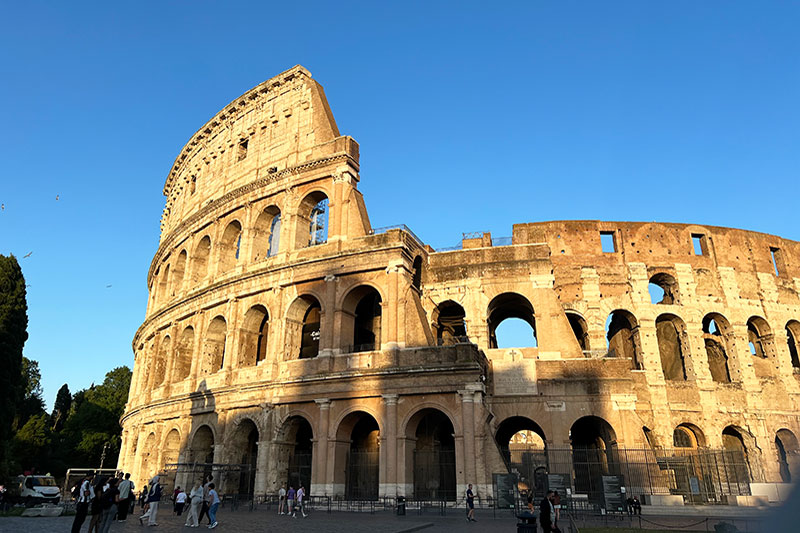
Twelve Missouri State University students and religious studies professor Dr. Vadim Putzu traveled to Italy May 10-19 as part of the Education Abroad program, “A Booted History of Judaism.”
During their two-week visit, the group first stopped in Rome, then traveled to Apulia, Italy’s southern “heel” region. The last part of their itinerary included an overnight train ride to Venice.
Throughout their journey, the group visited archaeological parks, museums, burial sites, synagogues, churches and Jewish quarters. They met local scholars and community members. They also polished their Italian language skills whenever possible.
Participating students were Lisa Brackenridge, Evelyn Carter, Alexander Geringer, Beth Hallmark, Abigail Hardwick, Justice Jones, Hailie Mongillo, Mallory Morton, Mason Oliver, Ilene Smith, Emma Thomas and Isabella Wrisberg.
Focus on Jewish history and culture
Putzu, a historian of Jewish thought, explained that Italy has had a small but important Jewish community since the ancient Roman era.
“Rome has one of the oldest synagogues in the world, Venice the first ghetto, and Apulia—the ‘heel’ of Italy—was the cradle of Jewish scientists and mystics, converts and refugees,” he said.
For the course Putzu, who was born and raised in Italy, included several pre-departure and on-site activities emphasizing Jewish history and culture. Through those activities, students gained insight into Jewish religious ideas and practices, major events in postbiblical Judaism and cultural topics such as the Jewish Diaspora.
Since his research focuses on medieval Jewish philosophers and mystics who lived in Italy, the Education Abroad experience lets Putzu share his scholarship, cultural background and intellectual interests with his students.
“It is rewarding to see that students sense this and are profoundly impacted,” he noted.
“Tour guide” activity enhances learning experience

For one assignment, students had to research a designated itinerary site prior to departure and develop an accompanying guidebook. Once on site, they served as “tour guide.”
Senior Lisa Brackenridge enjoyed the guidebook assignment the most.
“We learned far more than we ever could from a textbook chapter,” Brackenridge said. “Hearing each other’s tours in Italy made every site more meaningful and connected to our coursework on Jewish history.”
Brackenridge, a psychology and religious studies double major, researched Scola Nova. This was a medieval synagogue in Trani, also located in Italy’s “bootheel” region.
“I learned not only its history, but its story,” Brackenridge said. “When you are inundated with historical sites in every direction you turn, it’s easy to get overwhelmed by everything you will see. Having this assignment created meaning where we would have otherwise just seen another building.”
“Where lives were lived”
In another assignment, students researched a specific event in Italian Jewish history, relying heavily on autobiographical sources. According to Putzu, using personal stories as sources encouraged students to connect their research to what they encountered once in Italy. They could then refine their research “by personally experiencing the historical sites where lives were lived and events happened,” he explained.
Students also made powerful connections between their assigned readings and places they visited where those individuals lived. In one example, they read the diary of Leone Modena, then visited his synagogue and burial site. A famous and influential 17th century Venetian rabbi, Modena’s sermon audiences often included Christian clergy, Putzu noted. Unfortunately, Modena suffered from a gambling addiction that wreaked havoc on his family.
In another example, the students read the record of Filippo DeNis’ Inquisition trial, then visited the courthouse and jail where he was held. A Portuguese man who lived in Venice, DeNis converted to Christianity but was suspected of secretly living as a Jew.
“As they literally walked the same streets, saw the same buildings, and breathed the same air these two 17th-century Jews did, students were touched by the tragic complexities of their lives,” Putzu said.
Twentieth century contexts
The Museum of Memory and Hospitality in Santa Maria al Bagno also left a deep impression, Putzu noted.
“The whole village served as a displaced persons camp at the end of World War II,” he said. The town temporarily housed hundreds of Jewish Holocaust survivors who were waiting to rebuild their lives in Israel or elsewhere.
“These Jewish refugees were welcomed by the local population, went back to school and trained for jobs, formed families, and gradually returned to life after the horrors of the war,” Putzu said.
From classroom to catacombs
Abigail Hardwick is a second year master’s student in international affairs at Missouri State. She felt the program’s emphasis on Jewish history would complement her undergraduate background in religious studies.
“I not only learned so much about Italy, but [I] also gained a much deeper understanding of Judaism,” she said.
Hardwick especially appreciated the opportunity to experience rare and unusual activities. “On our first day, we got a personal lecture and an in-depth look at the Archive of the Jewish Community in Rome,” she said. “We saw books, writings and Torahs that were centuries old. I have never been so close to such rare artifacts.”
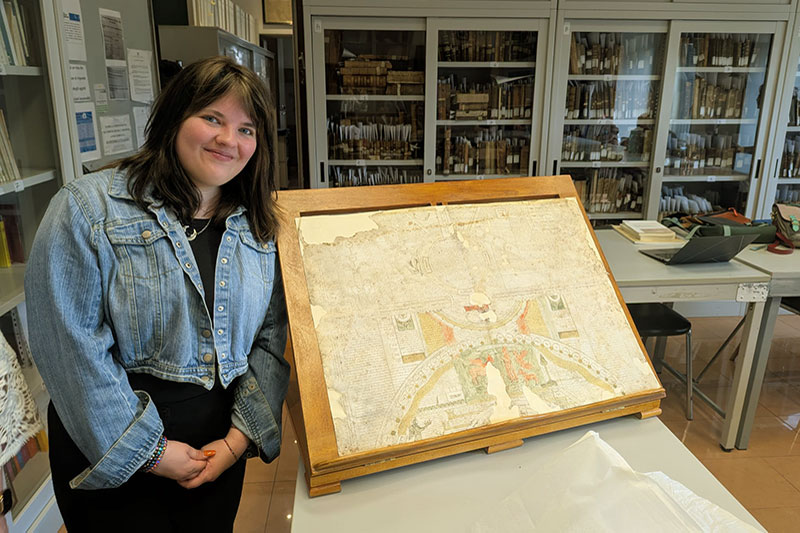
Her favorite experience was touring the Jewish catacombs, located on the outskirts of Rome. “Unlike the Christian catacombs, these are notoriously hard to get into,” she said.
Additionally, Hardwick learned more about Italian history in general. “I was able to discover Italy’s political past through its architecture,” she said. “[This] is not something you can learn unless you’re seeing it with your own eyes.”
More than you can imagine
Although developing an Education Abroad course requires hard work and patience, Putzu said the effort is worth it. “These programs are life-changing for students.”
“Don’t go with a preconceived agenda of places you need to see,” Brackenridge advised future Education Abroad students. “You will get to see and experience so much more than you can possibly imagine.”
“It is hard to find the words to describe how impactful it was,” Hardwick added. “Even now, I find myself looking back at my time and discovering new things to be in awe of.”
Explore Education Abroad @ Mo State
Photo credits: Lisa Brackenridge and Abigail Hardwick.
Reynolds College blog posts are human researched, written and reviewed unless otherwise indicated.
Discover more from Reynolds College Blog
Subscribe to get the latest posts sent to your email.
[…] successful Education Abroad programs for the 2025-26 year. Two of those programs—Ecuador and Italy—have already been featured in RCASH News. We conclude our coverage of these programs by heading […]