
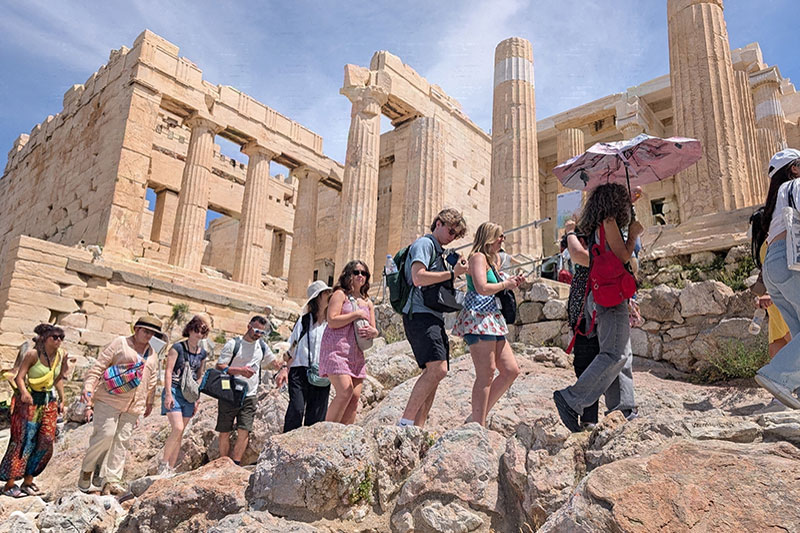
The Reynolds College of Arts, Social Sciences and Humanities (RCASH) produced several successful Education Abroad programs for the 2025-26 year. Two of those programs—Ecuador and Italy—have already been featured in RCASH News. We conclude our coverage of these programs by heading to Greece.
Thirteen students and two faculty from Missouri State University helped launch the inaugural Education Abroad experience in Greece May 11-22, 2026.
The students were Nadia Adamson, Teagan Allison, Alia Barker, Katherine Bracy, Cal Bussen, Michaela Dickey, Sylvie Edwards, Loren Halmick, Ava Hurley, Scout Hutchinson, Sav Jordan, Julie Kate Moylan and Gabrielle Stonehouse.
Faculty members Dr. William Harwood and Nikki Ferry led the interdisciplinary program, “In the Footsteps of Titans and Gods: An Immersive Exploration of Philosophy and Theatre in Greece.”
When they applied for the Education Abroad Faculty Fellows inaugural cohort, Harwood and Ferry each selected Greece as their destination. The happy coincidence created an opportunity for them to collaborate.
“[We] were very excited to explore how our two disciplines, philosophy and theatre, intersected while imparting our love of the country of Greece to our students,” Ferry said.
Harwood is an associate professor in the Department of Political Science and Philosophy. Ferry is an assistant professor in the Department of Theatre and Dance.
Diverse itinerary reflects history and culture
Starting in Athens, the group first visited the Acropolis. Harwood also gave a personalized tour of the National Archaeological Museum (NAM), which holds the largest collection of ancient Greek antiquities in the world.
Ferry guided the students through the Theatre of Dionysus, the location of City Dionysia.
“City Dionysia was the ancient Greek theatre festival,” Ferry explained. “The ‘big three’ Greek tragedians—Aeschylus, Sophocles and Euripides—competed in competitions for best tragedy and best comedy.”

The group then visited the ancient site of Delphi and nearby Mer des Oliviers, a five-generation family-owned olive grove. While there, they learned about olive cultivation and participated in an olive oil tasting.
“Some of the same trees whose oil lit the lamps in the Oracle are still alive, still producing olives,” Harwood said. “Some are over 5,000 years old!”
Other sites on the itinerary included Nafplio, the ancient civilization of Mycenae and the Epidaurus theater. Their final activity was dinner in Athens on Mount Lycabettus, where they enjoyed a 360-degree view of the city while they dined.
Senior Michaela Dickey said the program—short-term, faculty-directed, and with content that reflected her academic interests—was a perfect fit. She is majoring in anthropology with minors in archaeology and history.
“It was one of the few programs that included aspects of history and archaeology,” Dickey said. “I wanted to do a program where I could still gain knowledge pertaining to my chosen field of study.”
Rigorous academic prep
Before they traveled, however, the class attended several pre-departure class sessions. During these meetings, they discussed assigned readings and presented preliminary research on historical and cultural topics.
The entire class read Plato’s “Apology” and Sophocles’ “Antigone.” In addition, students partnered together to read and present on two additional texts. Among those were smaller excerpts from Homer’s “Iliad,” Plato’s “Republic,” Thucydides’ “Peloponnesian War,” Plato’s “Crito,” Aeschylus’ “Agamemnon” and Aristotle’s “Poetics.”
“At first, I was overwhelmed by the amount of reading,” Dickey said. “But I am so grateful that I did the assignment[s]. It definitely heightened my experience to have that background knowledge when visiting those specific places.”
“Outside of the lectures from the professors, which I found to be the most interesting part of our learning, I really enjoyed reading parts of the ‘Iliad’ and getting to present to my class about it,” said Sav Jordan, a junior BFA Acting major and dance minor. “I’ve wanted to go to Greece since I first read the Percy Jackson series in middle school.”
Ferry and Harwood also divided the class into small groups and assigned them a specific location on their itinerary. As designated “experts,” the students researched their assigned sites, then presented their findings to the class.
Jordan especially enjoyed this assignment. “We got the opportunity to continue to teach our peers even outside the classroom,” she said. “It gave us a personal connection to what we were learning.”

Making meaningful connections
Often during their stay, Harwood took the opportunity to highlight connections between Greek political history and philosophy and modern understandings of democracy. While visiting Philopappos Hill, for example, he gave an informal talk on Socrates, which complemented Plato’s “Apology.” The site is believed to be the location of Socrates’ prison cell.
Harwood noted that Socrates was the first person ever to be executed solely for their words and beliefs. “These words/beliefs were not religiously-based but rather about speaking truth to power and questioning the status-quo,” he explained. Socrates “is a vital precursor to our contemporary conceptions of justice, freedom, civil rights, civil disobedience, democracy and the First Amendment.”
“This was a very moving experience for the students,” Ferry recalled. “For me, too, this was a powerful moment when the location and site became the classroom.”
Harwood admitted he gets a little emotional each time he visits the site. This time, though, he was pleased to see people joining their group to hear his discussion. “We had peeled random tourists hailing from different nationalities off from their own activities who overheard our conversation and approached slowly to listen.”

May 2027: Greece 2.0
Ferry and Harwood are working on a second Education Abroad experience to Greece, tentatively scheduled for May 2027. They hope to retain the program’s robust academic rigor, expand on cultural and historical experiences and reduce costs.
For Dickey and Jordan, being in the inaugural cohort was priceless.
“Our trip to Greece was one of the best experiences of my life,” Dickey said. “I would not trade it for anything. Education Abroad is one of the best ways to learn.”
“There is truly nothing like exploring a new country, culture, language and experience with your peers,” Jordan said. “It was truly a core memory in my life, and I know I will never forget it. I’m already itching to go back!”
Explore Education Abroad @ Mo State
Photo credits: William Harwood and Nikki Ferry.
Reynolds College blog posts are human researched, written and reviewed unless otherwise indicated.
Discover more from Reynolds College Blog
Subscribe to get the latest posts sent to your email.