
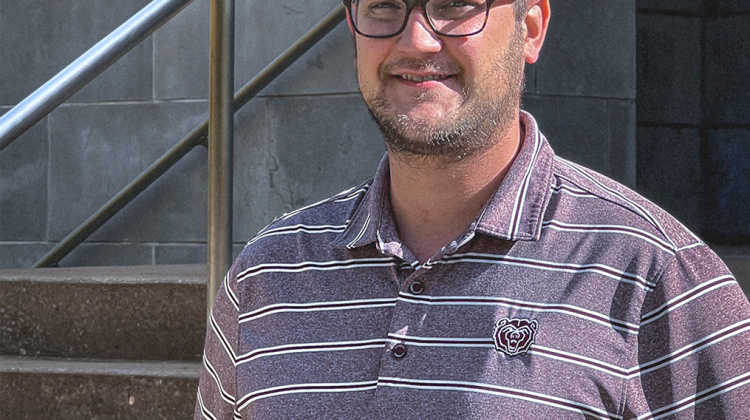
For Jordan Politte, stepping into a leadership role at Missouri State University’s College of Education is about more than the next step in his career. It is an opportunity to help shape the future of a program with a 40-year history of supporting educators and students with autism.
Politte recently became the director of Project ACCESS, a program within the College of Education that provides professional development and support to educators working with students with autism. In this role, he collaborates with the Missouri Department of Elementary and Secondary Education (DESE) to oversee the program, lead its team and ensure Project ACCESS continues to meet its goals.
“I think for me, I’m most excited about improving the practice of teachers for kids with autism,” Politte said.
That goal is especially important as educators continue to seek effective ways to support students with autism in the classroom. Politte hopes Project ACCESS can help teachers across Missouri feel more confident in their ability to meet those students’ needs.
“The long-term goal would be that all teachers have confidence with supporting kids with autism and have the ability to teach those kiddos to the best of their ability,” Politte said.
A New Chapter in a Familiar Place
Although the director position represents a new chapter for Politte, the College of Education is far from unfamiliar.
Before taking on the role, Politte spent nearly nine years as a trainer with Missouri State’s Agency for Teaching, Leading and Learning, providing professional development to educators. Before joining Missouri State, he worked as a special education teacher.
The move into the director position was an opportunity for professional growth and a chance to take on a new leadership challenge.
“When this position came open, I was encouraged to explore it,” Politte said. “So, it was really just about professional growth.”
The transition also brings Politte back to a university that played an important role in his development as an educator. He earned both his bachelor’s and master’s degrees from Missouri State and credits the hands-on experiences he gained through the College of Education with shaping his approach to teaching.
“I had several classes that had practicums attached to it where I was able to get into classrooms and see great teaching happen,” Politte said.
Connecting what he learned in the classroom with real-world experiences helped Politte develop a deeper understanding of education and the work of teaching.
“Being able to practice and learn about something in a classroom, but then go and see it in practice in person with kids really kind of changed how I saw education and how I saw the job of teaching.”
Now, Politte hopes to help create similar opportunities for future educators, connecting what they learn in their coursework with practical strategies they can use in their own classrooms.
Building the Next 40 Years
As Project ACCESS celebrates four decades of work, Politte is looking beyond the program’s history to consider what its next chapter can accomplish.
“Project ACCESS has been around for 40 years,” Politte said. “So what’s the next 40 look like?”
For Politte, building that future starts with establishing a strong, sustainable team culture. One of his primary goals during his first year is to create an environment where team members feel supported, take pride in their work and remain committed to the program’s mission.
“Creating a culture where people want to stay, people want to work, people are passionate about the work and want to continue the movement, so to speak,” Politte said.
He also plans to develop a strong training protocol that focuses on both the content Project ACCESS delivers and how that information is shared with educators.
Together, these efforts will help strengthen the program’s foundation and support its continued work with teachers across Missouri.
Beyond Project ACCESS itself, Politte sees an opportunity to strengthen the program’s connection with Missouri State’s future educators.
Students in education programs may encounter autism and special education through coursework and field experiences, but Politte believes there is room to provide more direct exposure to evidence-based practices for supporting students with autism.
“I would love to be more integrated into some more classrooms here on campus where we’re talking to future teachers about autism and kids with autism and those practices and how to support kids with autism,” Politte said.
One of Politte’s goals is to ensure future Missouri State educators graduate with a stronger understanding of Project ACCESS and the strategies they can use to support students with autism in their own classrooms.
That vision reflects what he valued most as a College of Education student: learning through experience and seeing effective teaching in action.
Now, Politte has the opportunity to help provide those experiences for future educators while leading Project ACCESS into its next chapter.
“I think that would be the biggest achievement for me,” Politte said, “really letting the teachers that graduate from Missouri State know about Project ACCESS as a whole, but giving them that introduction to supporting kids with autism as well.”
Learn more about Project ACCESS at projectaccess.missouristate.edu


