Missouri State University

Skip to content Skip to navigation
a b c d e f g h i j k l m n o p q r s t u v w x y z

College of Education News

Student leader prepares to become special education teacher

November 22, 2024 by Morgan E. Tinin

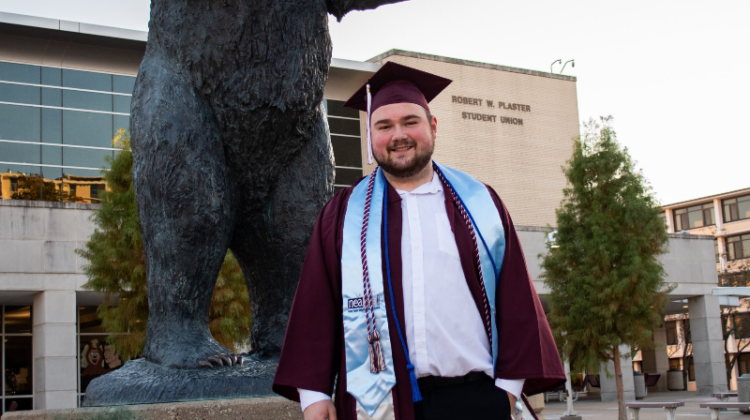
Faron Haase in his graduation attire standing in front of the Bear statue at Plaster Student Union.

One Missouri State University student who will complete his undergraduate degree this December is senior Faron Haase. 

After studying at Missouri State since fall 2020, Haase will receive his bachelor’s degree in special education and a minor in literacy. He has made the most of his time at Missouri State and displayed genuine commitment to his community and students.   

On campus engagement 

Haase, a native of Joplin, Missouri, has taken on many roles during his time at the university. It might be easier to find a club or organization he has not been a part of.  

A few of the leadership hats he has worn include: 

  • University Ambassadors president (fall 2023-spring 2024) and new member liaison (fall 2022-spring 2023) 
  • Homecoming Committee marketing coordinator (2021-2022) and committee chair (2023) 
  • Greek Week unaffiliated points coordinator (spring 2022) 
  • Residence Hall Association president (2021-2022) 

Haase notes juggling his studies and extracurricular activities has helped him with time management.  

“It was hard to learn to delegate but also stay involved in all the things I wanted to do,” he said. “I just had to remember how much I enjoyed what I was doing, learn to prioritize and focus.” 

Mentorship from cooperating teachers
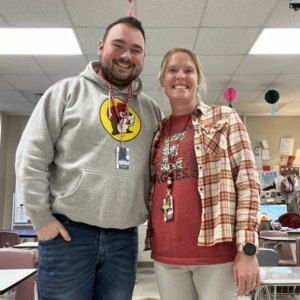
Faron Haase with his cooperating teacher Rachel McGowan

Haase chose special education because of his desire to help students with disabilities learn and thrive. He admits that he struggled with his classroom confidence initially, but his time at Missouri State has made him more comfortable.  

“I fought a lot of imposter syndrome as far as, ‘what gives me the right to come into a classroom and expect students to care what I have to say,’” he said. “My time in the College of Education has made me more confident in my ability to teach my students.” 

He is currently a student teacher in a ninth-grade special education classroom at Nixa High School with two cooperating teachers: Rachel McGowan and Lindsey Hamilton. Together, they teach English and mathematics. 

The three have formed a close friendship and built a lot of trust among them.  

“We can really feed off each other’s energy,” Haase said. “We know when we’re not having a good day and can talk to each other about anything.” 

He shares they even try to find ways to incorporate their humor and personality in their lessons.  

“When we introduced the budgeting unit, we performed a skit,” he said. “I explained I’m a college student, so I don’t have money, and Rachel prompted me with questions to get our points across.” 

Pursuing a master’s program 

Haase will continue his studies at Missouri State in the educational technology graduate program. His undergraduate classes shaped his interest in the field. 

“I took one course related to educational technology and performed the best I’ve ever performed in a class,” he said. “I spent a lot of extra time focusing on the class because I loved it.” 

His goal behind this specific degree path is to connect better with his students.  

“We live in a modern age and the new tech for education is expanding. I want to learn more about how to understand my students better,” he said. “That’s what technology in education does; it teaches the teachers how to reach students in ways humans can’t.” 

Although he only started working with his current students during student teaching, they mean the world to him. 

“My students mean everything – there’s no job without them,” he said. “They’re how I have a job that makes me happy. I’ve only been in this school for 12 weeks, but they’re part of me now.” 
Learn more about the College of Education

Filed Under: COE Students Tagged With: educational technology, Special Education, student spotlight, Student Success

Gaining access to the world

November 30, 2021 by Strategic Communication

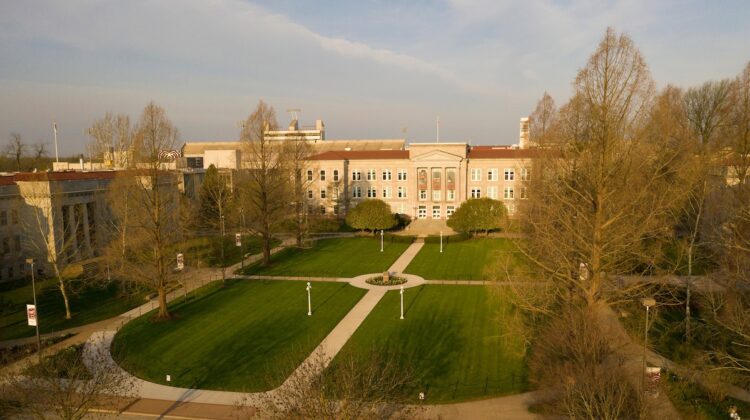
aerial view of campus

Imagine walking down a sidewalk, getting on a bus or boarding a plane.  

Now imagine accomplishing them without sight.  

Missouri State University’s orientation and mobility (O&M) program trains students how to assist individuals with visual impairments. This includes providing individuals with the tools and experience they need to navigate the world independently.  

Missouri State also offers the blindness and low vision teacher education (B&LV) program. The program ensures that teachers can provide the accommodations necessary for students with visual impairments to excel in the classroom. 

“Blindness and low vision are low incidence disabilities, so they can get pushed aside,” Dr. Shari Scott, B&LV program coordinator, said.  

“Even if you have just one person who needs Braille or access to large print, it’s worth providing that support.”  

The O&M and the B&LV programs at MSU recently received national accreditation from the Association for Education and Rehabilitation of the Blind and Visually Impaired (AERBVI). 

The difference access can make  

Providing visually impaired students with accommodations in the classroom is crucial to allowing them to participate in everyday life.  

Dr. Christopher Craig, deputy provost at MSU, learned this at a young age when attending the Missouri School for the Blind. He credits the school with much of his success in discovering how to navigate his environment despite his visual impairment.  

“Part of what I’ve been able to do in my life, including being deputy provost, is because I had a strong skill base for learning how to cope and communicate,” Craig said. “Every kid deserves to be taught reading by a qualified teacher.” 

The blind and low vision certification ensures that students with visual impairments can manage classroom materials like textbooks, course websites and other media that is consumed visually.  

As the skills needed for success go beyond the classroom, the orientation and mobility program covers everything from cane skills to public transportation and metro travel. 

To get an O&M certification, students spend more than 20 hours under a blindfold learning the skills they will be teaching to individuals with visual impairments.  

“Even if someone can read Braille and access the world digitally, they may not feel comfortable hopping on a plane and going to Brazil,” Scott said. “Learning orientation and mobility opens up the world.”    

Explore the O&M program  

A broader vision  

Craig began developing these programs at MSU with the hope that they would produce the specialized instructors needed to better serve people with visual impairments.  

“I started this program in Missouri because there were children with visual impairments who needed greater care. They weren’t learning Braille, communication skills or how to use assistive technologies,” Craig said.  

“There also was nothing in Missouri to help these children learn how to physically get around.”  

With proper accommodations, people with visual impairments can meet their full potential alongside their sighted peers.  

“Having a job brings self-fulfillment and self-actualization,” Scott said. “If you have a sensory deprivation, such as hard of hearing or blindness, you can benefit from a specialized instructor to help you navigate functional skills. 

“One of my former students was the first blind student to go to Columbia University in New York. The things he is doing in journalism today are totally amazing.” 

MSU is bringing these necessities to students who need them, providing opportunities for them that would otherwise be inaccessible.  

“This is bigger than just the university,” Scott said. “The K-12 kids in Missouri who don’t have instructors are front and center for us, but preparing specialized instructors goes beyond that. We are part of a global endeavor to improve accessibility.”  

About the accreditation 

While the B&LV program receives its teacher-certifying credentials from the Missouri Department of Elementary and Secondary Education (DESE), the AERBVI accreditation endorses the program as effective preparation.  

For the O&M program, the AERBVI is the certifying body. The accreditation allows for students in MSU’s O&M program to graduate fully licensed.  

MSU is one of just 12 universities with an accredited O&M program across the United States. 

Learn more about the accreditation 

Tagged With: counseling leadership and special education, diversity, education, School of Special Education Leadership and Professional Studies, Special Education

Creating pathways for paraeducators

October 20, 2021 by Strategic Communication

Missouri is facing a teacher shortage.  

Information from Missouri Department of Elementary and Secondary Education (DESE) shows that special education teachers rank in the top three certification areas in need of fully certified teachers to fill vacancies across the state. 

Faculty in Missouri State’s  College of Education are striving to create a solution to this shortage. They developed Pathways for Paraprofessionals, an alternative pathway to certification for paraeducators in Missouri schools.  

Paraeducators assist special education teachers throughout the school by supporting individualized education plans across academic and behavioral realms. 

“Paraeducators are already working in special education and already have a desire to work with kids with special needs,” said Dr. Reesha Adamson, associate professor in the department of counseling, leadership and special education (CLSE) at MSU. “We had to think about how we can support this population of individuals in accessing a degree.” 

Eliminating barriers 

The Pathways for Paraprofessionals program is funded as part of the Workforce Innovation Opportunity Act. It’s designed to remove many of the barriers that prevent paraeducators from returning to college and completing their degree. 

“Pathways for Paras is a great way to ‘think outside of the box’ as we attempt to increase the number of people who will become teachers,” Dr. Jon Turner, associate professor in the CLSE department, said.  

Learning at work 

While it is not uncommon for paraeducators to be in the traditional degree program, the traditional path is not always conducive to students who work full-time.  

“We created a track where school districts partner with us to develop cohorts within their districts,” Adamson said. “The track is unique because about half of the classwork for those final two years is taught at the school district.”   

Bringing the classwork to the districts has several benefits, allowing teachers to focus on the curriculum in the schools where they already work. 

“They’re able to talk about best practice as it applies to their school district’s curriculum and then walk out the door and immediately apply those practices to the job that they’re doing every day,” Adamson said.  

Finding financial resources 

One of the biggest barriers for nontraditional students is a lack of financial assistance.  

“Many potential teachers cannot travel the traditional route to get a teaching degree,” Turner said. “They need a job while they pursue their degree and just can’t afford to attend college full-time.”   

The U.S. Department of Labor recognizes paraeducator as a skilled apprenticeship, allowing Pathways for Paraprofessionals to be designated as an apprenticeship program. 

This opened funding opportunities, making higher education achievable for nontraditional students who are already working as paraeducators.  

“For paraeducators who are interested in this program: Do not let anything stop you from achieving your dreams of higher education,” Adamson said. “There are so many resources out there. Our goal is to try to make this as affordable as possible for each individual in this program.” 

Explore the Pathways for Paraprofessionals track 

Tagged With: counseling leadership and special education, education, School of Special Education Leadership and Professional Studies, Special Education

Categories

  • Bear POWER
  • Child Life Studies
  • COE Alumni
  • COE Faculty
  • COE Staff
  • COE Students
  • Counseling
  • Early Childhood and Family Development
  • Educational Administration
  • Elementary Education
  • Graduate Program
  • Literacy
  • Middle School Education
  • Secondary Education
  • Special Education
  • Student Affairs
  • Uncategorized

Archives

Meta

  • Log in
  • Entries feed
  • Comments feed
  • WordPress.org
  • Accessibility
  • Disclaimer
  • Disclosures
  • Equal Opportunity Employer and Institution
  • © 2026 Board of Governors, Missouri State University
  • Contact Information