
Missouri State University

Skip to content Skip to navigation
a b c d e f g h i j k l m n o p q r s t u v w x y z

Brand Updates

Associated Press style updates: Capitalization of Black and Indigenous

June 25, 2020 by Strategic Communication

Aerial shot of hands typing on keyboard

There is an important change to AP style with regard to the capitalization of Black and Indigenous.

From now on, capitalize Black in a racial, ethnic or cultural sense. This conveys an essential and shared sense of history, identity and community among people who identify as Black, including those in the African diaspora and within Africa. The lowercase black refers to a color, not a person.

Also, capitalize Indigenous in reference to original inhabitants of a place.

These two changes align with long-standing capitalization of other racial and ethnic identifiers, such as Latino, Asian American and Native American.

The updates become part of the AP Stylebook’s race-related coverage guidance, which begins:

“Avoid broad generalizations and labels; race and ethnicity are one part of a person’s identity. Identifying people by race and reporting on actions that have to do with race often go beyond simple style questions, challenging journalists to think broadly about racial issues before having to make decisions on specific situations and stories.

“In all coverage — not just race-related coverage — strive to accurately represent the world, or a particular community, and its diversity through the people you quote and depict in all formats. Omissions and lack of inclusion can render people invisible and cause anguish.”

Missouri State has a limited membership to the online AP Stylebook. More information on each of these entries is available in the online guide. If you create content for the university, contact Andrea Mostyn to request access.

Tagged With: associated press, News and updates

Associated Press style updates: Coronavirus

May 14, 2020 by Strategic Communication

Hands typing on computer keyboard

The Associated Press is maintaining a coronavirus topical guide that includes many rulings on spelling and common usage. The university is following this guide when writing and editing.

Missouri State has a limited membership to the online AP Stylebook. More information on each of these entries is available in the online guide. If you create content for the university, contact Andrea Mostyn to request access.

Updates and additions

coronaviruses (revised)

A family of viruses, some of which cause disease in people and animals, named for crownlike spikes on their surfaces.

The viruses can cause the common cold or more severe diseases such as SARS (severe acute respiratory syndrome), MERS (Middle East respiratory syndrome) and COVID-19, the latter of which first appeared in late 2019 in Wuhan, China.

Referring to simply the coronavirus is acceptable on first reference in stories about COVID-19. While the phrasing incorrectly implies there is only one coronavirus, it is clear in this context. Also acceptable on first reference: the new coronavirus or the new virus for the virus; COVID-19 for the disease caused by the virus.

Passages and stories focusing on the science of the disease require sharper distinctions.

COVID-19, which stands for coronavirus disease 2019, is caused by a virus named SARS-CoV-2. When referring specifically to the virus, the COVID-19 virus and the virus that causes COVID-19 are acceptable.

But, because COVID-19 is the name of the disease, not the virus, it is not accurate to write a new virus called COVID-19. Also incorrect are usages such as COVID-19 spreads through the air; scientists are investigating how long COVID-19 may remain on surfaces; she worries about catching COVID-19. In each of those, it should be the coronavirus, not COVID-19.

Do not shorten to COVID, even in headlines, unless part of a quotation or proper name.

In stories, do not refer simply to coronavirus without the article the. Not: She is concerned about coronavirus. Omitting the is acceptable in headlines and in uses such as: He said coronavirus concerns are increasing.

Common symptoms of COVID-19 include fever, cough, breathing trouble, sore throat, muscle pain, and loss of taste or smell. Most people develop only mild symptoms. But some people, usually those with other medical complications, develop more severe symptoms, including pneumonia.

SARS is acceptable on first reference for the disease first identified in Asia in 2003. Spell out severe acute respiratory syndrome later in the story.

MERS is acceptable on first reference for the disease first identified in 2012. Spell out Middle East respiratory syndrome later in the story.

COVID-19

All capitalized; stands for coronavirus disease 2019.

cancel, canceled, canceling, cancellation

CARES Act

Avoid using this term unless in a direct quotation in reference to the Coronavirus Aid, Relief and Economic Security Act. Instead, use phrasing such as the coronavirus relief bill, the coronavirus aid bill, the coronavirus rescue package, etc., for the U.S. government’s $2.2 trillion package to help businesses, workers and the health care system. Do not refer to it as a stimulus or a stimulus package, etc.

contact tracing (new)

The practice of tracking down and monitoring people who have been in close proximity to someone who is infected. Do not enclose in quotation marks. Include a hyphen for clarity when used as a modifier: The state’s contact-tracing efforts. Consider rephrasing to avoid the term or for variety: The state’s efforts to identify people who have had close contact with the nursing home worker.

contagion (new)

Avoid this term. Usually better to use words like disease or illness, or more specific words like virus.

distance learning (n., adj.)

No hyphen. Examples: Schools are turning to distance learning. He is taking a distance learning class.

epidemic, pandemic

An epidemic is the rapid spread of disease in a certain population or region; a pandemic is an epidemic that has spread worldwide. Follow declarations of public health officials when writing. On March 11, the World Health Organization declared the COVID-19 outbreak a pandemic. Do not write global pandemic, which is redundant.

hand-washing

Use a hyphen.

health care

Don’t use a hyphen.

nonessential

Do not use a hyphen.

patient

Only use if someone is being or has been treated by a medical professional. The vast majority of people with the virus are not hospitalized, and some may not seek care, so avoid using patients to refer to all people with the virus.

personal protective equipment

Don’t use PPE. If necessary to use PPE in a direct quotation, spell it out and explain the term.

shelter in place (v.), shelter-in-place (adj.)

Examples: The governor urged residents to shelter in place. Authorities issued a shelter-in-place order.

stay at home (v.), stay-at-home (adj.)

shutdown (n.), shut down (v.)

social distancing, socially distancing

No quote marks, no hyphen: Examples: The CDC is urging social distancing. The parents are taking social distancing precautions. They’ve been socially distancing themselves.

telecommute, telecommuting, telecommuter

teleconference, teleconferencing

telemedicine

travel, traveled, traveling, traveler

videoconference, videoconferencing; video chat

virus’s

The singular possessive form of virus. Not virus’.

Tagged With: associated press, News and updates, writing

A digital #BearGrads experience

May 11, 2020 by Strategic Communication

More than 2,800 students will graduate from Missouri State this week. Although we can’t celebrate them in person until later this year, we can still give you a way to express your pride online.

Facebook Frames

Click or tap on each image to open Facebook and test the frame on your profile picture.

For #BearGrads

Missouri State University Bear Grad with Boomer Bear Missouri State Bear Grad on maroon with graduation cap

For families

"So proud of my Bear Grad" in maroon and white"So proud of my Bear Grad" with walking Bear

GIPHY stickers and GIFs

We’ve loaded several #BearGrads-themed stickers and GIFs for you to use on Instagram, Snapchat and Twitter. Access the collection or search using the “beargrads” tag.

Access the collection

YouTube congratulations from President Smart, deans and administrators

President Clif Smart, deans and administrators recorded messages of congratulations to the class of 2020.

Filed Under: downloads and resources Tagged With: beargrads, News and updates, social media, Social Media Kit

Learn how to tell MSU’s story at MarCom Training Week

December 12, 2019 by Strategic Communication

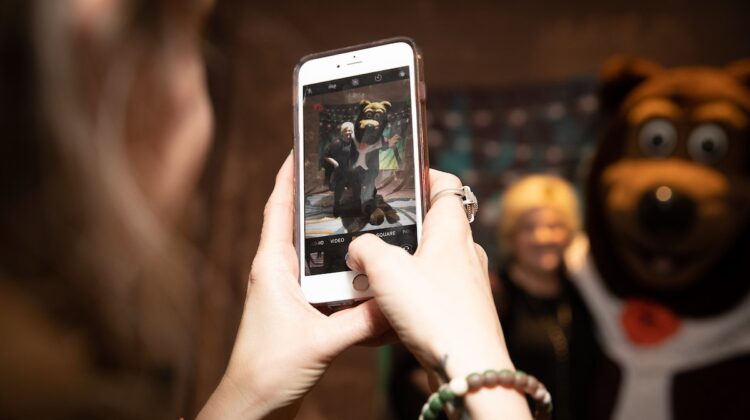
Taking pictures of Boomer Bear is fun.

Here’s the perfect New Year’s resolution: Serve your Missouri State audiences better than ever. We can show you how in just one week.

The division of marketing and communications will present the first MarCom Training Week Feb. 3-7, 2020, at Plaster Student Union 308. All sessions are free. Registration is required on My Learning Connection via My Missouri State.

Register now

The schedule

Feb. 3

How to sound like Missouri State, 9-10 a.m.

  • How to write about Missouri State within brand.
  • Assistance available within the brand website.
  • What style to use when writing for the university.
  • Best practices for readability.

How to look like Missouri State, 10:15-11:15 a.m.

  • Brand visual guidelines.
  • What brand resources are available.
  • How to use university logos and branding elements.
  • Best practices for designing within the brand.

Feb. 4

Making your statement with video, 2:30-4:30 p.m.

  • The goals of using video.
  • How to plan your video shoot.
  • What techniques you can use to improve your video quality.
  • How and when to live-stream.
  • Resources to help you shoot, edit and release your videos.

Feb. 5

Making your statement with social media, 9-11 a.m.

  • Choosing and creating a profile.
  • Discovering what content works best on each platform.
  • Branding your department or college across channels.
  • Delivering good customer service.
  • Effective tools.

5 blogging tips for beginners, 1-2 p.m.

  • Getting started (creating a blog, adding users and roles).
  • What to post on your blog (news, profiles/features, events).
  • Visuals (photos, video).
  • Text (readability, headings, linking).
  • Sharing and promoting your blog (social media, email, analytics).

Feb. 6

Publicizing your event with calendars and social media, 9-10 a.m.

  • Best practices for using Missouri State’s online calendar.
  • Keys to sharing events on social media.
  • Where to find other community calendar resources.

How to be a Web Press star, 10:15-11:45 a.m.

  • Which Web Press content groups to use.
  • Making your website usable and accessible for all.
  • How to create an action-oriented website.

Making your statement with photography, 1-2 p.m.

  • How to best utilize the office of visual media and make your photo request productive.
  • Ways to use your own camera or cell phone to get great photos.
  • How to work with people, lighting, handling releases and setting the stage for a beautiful image.

Feb. 7

Making your statement with media relations, 1-3 p.m.

  • Ways to prepare and practice for media interviews.
  • Why a strong appearance in a newspaper or on TV reflects well on you, your department and the university.

Tagged With: brand, photo, social media, Training, visual media

GA needed: Share MSU’s great stories

September 3, 2019 by Strategic Communication

Ready to begin your graduate education at your favorite university – Missouri State?

Have a talent for communication with a creative twist? We need you to help recruit students and be a brand ambassador for the university and its programs.

Get real-world experience

The office of university communications, in the marketing and communications division at Missouri State, has open graduate assistantships. You will have an opportunity to get hands-on experience with marketing, promotion, writing, editing and public relations. All of this while having your education paid for.

Here, you’ll:

  • Create content – blog posts and website copy, feature stories, social media posts, text for publications
  • Influence perception of the university and its programs
  • Learn and apply best practices for multiple platforms of traditional and social media
  • Participate in branding and strategy brainstorming sessions

Learn more

If this appeals to you, apply before Oct. 15.

Learn more about the position.

We want to hear from you. Follow the instructions in the postings to apply.

Tagged With: graduate assistantships, News and updates

« Previous Page
Next Page »

Categories

  • awards
  • downloads and resources
  • Inspiration
  • News and updates
  • Portfolio
  • Social Media Kit
  • templates
  • Training

Meta

  • Log in
  • Entries feed
  • Comments feed
  • WordPress.org
  • Accessibility
  • Disclaimer
  • Disclosures
  • Equal Opportunity Employer and Institution
  • © 2026 Board of Governors, Missouri State University
  • Contact Information