
Missouri State University

Skip to content Skip to navigation
a b c d e f g h i j k l m n o p q r s t u v w x y z

College of Education News

Little ripples make big impacts

February 14, 2024 by Strategic Communication

Headshot of Amber Allen

In her office, Amber Allen hangs up three maps: Missouri, the United States and the world.  

Allen, a Missouri State University alumna from Kansas City, Missouri, is a human development and family science field specialist at the University of Missouri Extension. While based in Springfield, she oversees 10 counties in the southwest Missouri region.  

She teaches in-person and virtual community education classes focused on stress management, childcare provider professional development, mental health, parenting, families and healthy aging. Participants have spanned from southwest Missouri to Canada and Japan. 

As a student at MSU, Allen interned with Community Partnership of the Ozarks. It was there she realized she wanted to work in community-based education as a profession. 

Allen finished her bachelor’s degree in child and family development in 2013. She furthered her studies with a master’s degree in nonprofit and civic leadership from Drury University. She is now pursuing her doctorate in education in educational leadership and policy analysis at the University of Missouri. 

Allen said Missouri State laid the foundation for her success — not only on the theory side of things, but also for the research and application skills she uses daily. 

Community education and social change 

Allen loves “connecting the dots.”  She does this by connecting individuals to classes or communities to opportunities. This is where her three maps come into play.   

“What I do here in southwest Missouri can affect the whole state. What is happening in Missouri can also make an impact across the country,” Allen said.   

“One thing you do, even as a student, can impact so many more than you know. Educating one individual or doing one family education event can create lasting change,” she said.  

These “little ripples” are key to the prevention-based education Allen champions. Often, her research focuses on stress management and mental health.   

As a certified family life educator and advanced prevention specialist, Allen shares her knowledge with field professionals. Through her classes, she can spread evidence and research-based education to the entire world. 

Advice for students

Allen has two main pieces of advice for students interested in her field: “Expect the unexpected” and “never take for granted a sticky note.”   

As a student, Allen struggled with finding an internship she felt was right for her. She spoke to one of her professors, who scribbled a phone number and a name on a sticky note. From this sticky note, she found an internship where she met many of her colleagues. The first steps to her current position started with an email address written on a napkin.  

“Those unexpected moments can set the trajectory of your career path,” Allen said. 

Because of this, she recommends getting to know classmates in your field. Allen believes many Missouri State students “bloom where planted.” Connections made in a simple group project can be a lifelong networking link for those who stay in the area. 

These local connections and opportunities spread outward. Allen has been a speaker at both the state and national level, most recently presenting a webinar on Guidance for Family Practitioners to Manage Stress for the National Council on Family Relations. Each new opportunity is another pin on her three maps. 

Taking the next steps 

If you told freshman Allen of her current successes, she would not believe you. But as she completed her degree, that mindset changed. MSU professors sharing their experiences showed Allen post-bachelor’s education was an exciting prospect. 

She said her mentors at Missouri State pushed her to take the next steps in education. Now, she is completing her doctoral program. 

According to Allen, the little ripples of opportunity she found at Missouri State have shaped her career. Through her work, she is able to help improve the well-being of individuals and families.
Learn more about child and family development programs

Filed Under: COE Alumni Tagged With: alumni, child and family development, child development, college of education, Early Childhood and Family Development

Stories of Healing in the Aftermath of Hurricane Dorian

December 5, 2019 by Abigail Blaes

Cara Smith with her team

In the wake of a disaster, there’s confusion. There’s fear. There’s grief. It can be nearly impossible for any person to process. 

For children, the trauma of a disaster can feel even more confusing and upsetting. 

According to NBC News, Hurricane Dorian was the most intense hurricane on record to hit the Bahamas. It is regarded as the worst natural disaster in the country’s history. Dozens of deaths have been reported and hundreds are still missing. 

Amid all this chaos and fear, groups of people gather from around the world to help. Cara Smith, child life clinical instructor at Missouri State, was one of those people. 

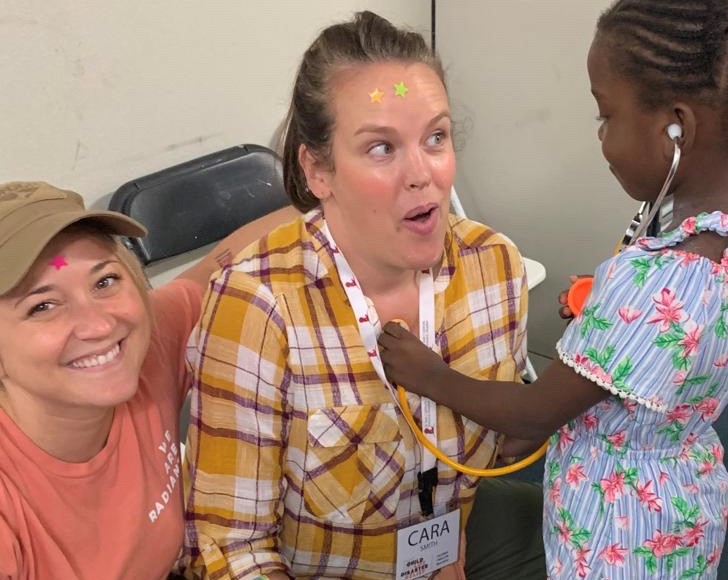
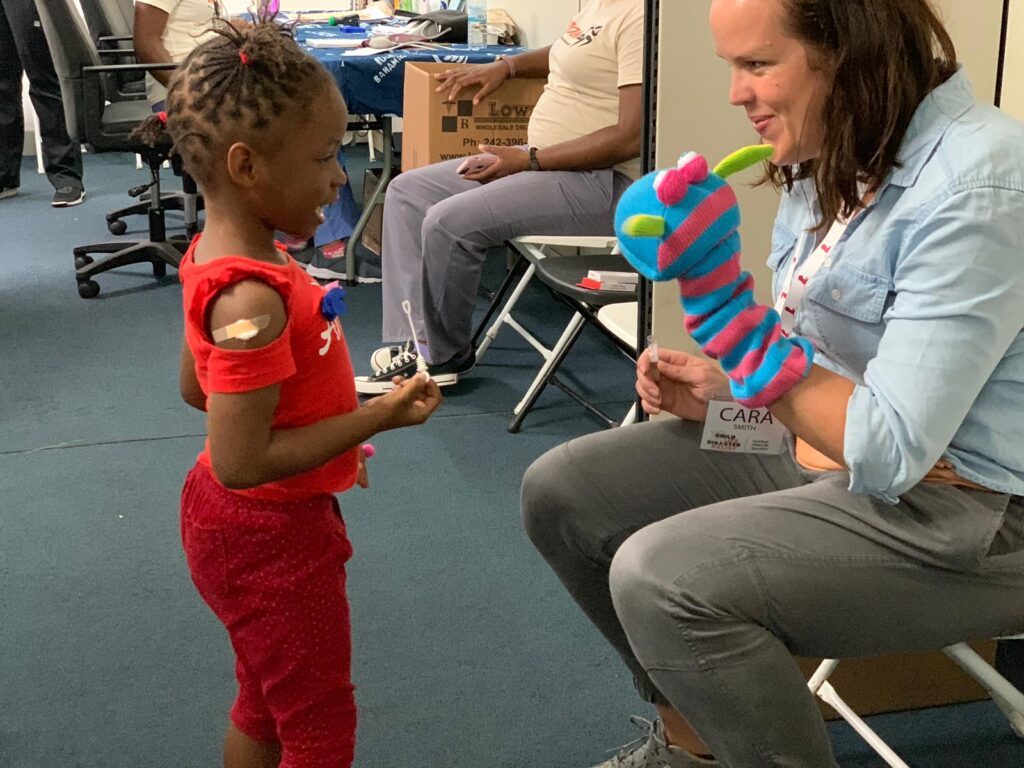
Cara Smith plays with puppets with a young girl

About Child Life Disaster Relief 

Smith went to the Bahamas with the nonprofit organization Child Life Disaster Relief. This organization sends child life specialists like Smith to places affected by disasters.  

These specialists integrate into the affected communities and help them find normalcy once again. 

“What we do is really just providing the tools to the kids,” Smith said. “We create a safe place for them to play out their experiences. Often times, as adults, our perception of what may be traumatic or what was challenging for them can be different than what a child is experiencing.” 

This is why the child life specialists support children through directed playtime. In other words, the specialists are there to provide a familiar way for children to express themselves. It’s a comfortable outlet for the kids to start processing what they experienced. 

There were three child life specialists first sent to the Bahamas; Smith was the leader of the group. 

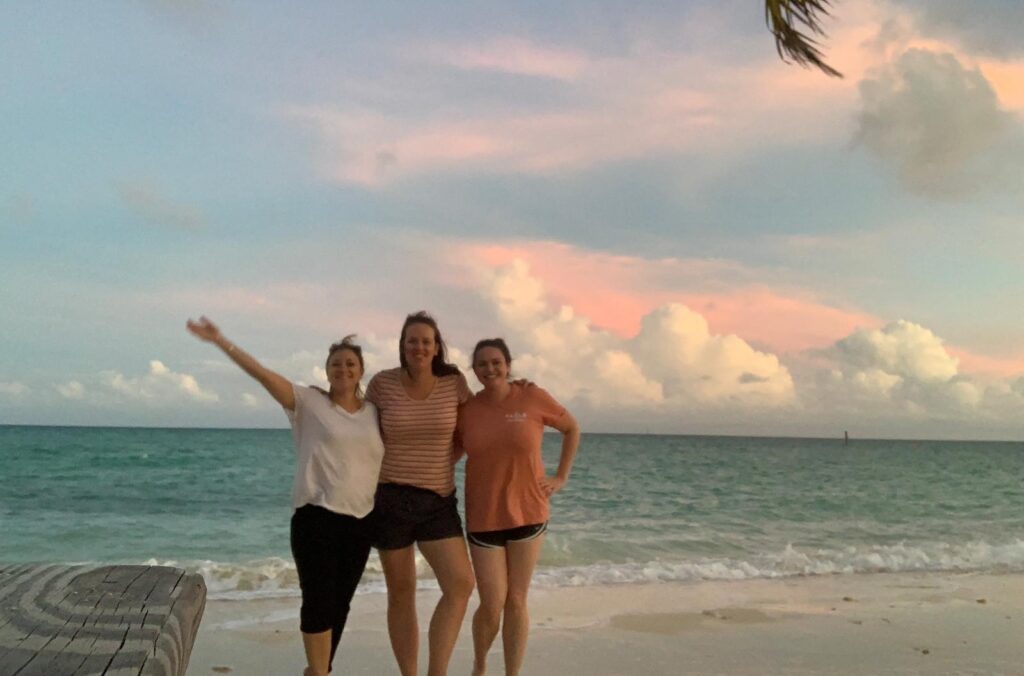
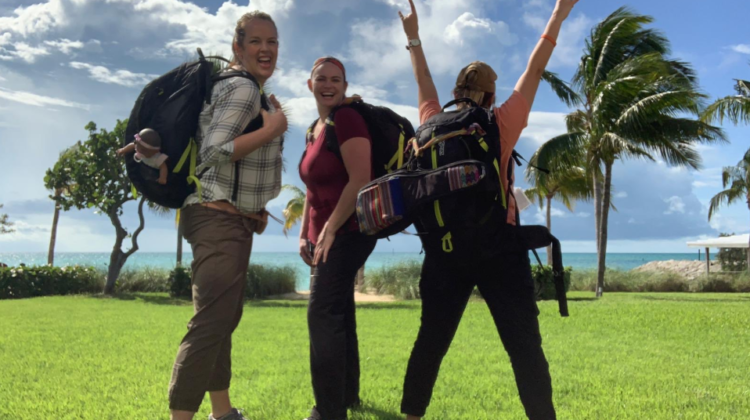
Cara and her team on the beach in the Bahamas
Cara (middle) and her team

In the Bahamas 

Smith and her team were directed to the island of Nassau. Nassau wasn’t severely impacted by the hurricane initially. However, it became the safe haven for those displaced by Hurricane Dorian. This is where Smith’s team began their work. 

Their first stop was a gymnasium with over 1,200 people living in it. Around 200 of them were children.  

“The first day we walked into that gym and the kids saw we had toys, it was like the masses erupted,” Smith said. “They had nothing, and this was something we could give them.” 

The toys were a gateway to creating connections with the kids. 

“I think sometimes, when people think of supporting kids in disaster situations, what they’re looking for is a smiley, happy ending,” Smith said. “But that’s not what we really have to do. We have to create space for whatever they’re feeling and tell them it’s okay to scream and cry. We just have to be there.” 

Stories of healing 

Smith recounted some of the stories that most impacted her during her time working with the children affected by Hurricane Dorian. 

We had a music therapist with us who was amazing. She did some songwriting with some of the kids. Of the group, several of them were teenage boys. They had a difficult time naming the things that they were feeling. One of the boys said that he thought the hurricane was funny. Clearly, this was his way of not really connecting fully to what he was really feeling.  

As the songwriting exercise continued, he started to open up about his best friend that he hasn’t heard from since the hurricane. He doesn’t know if she’s just lost her phone or if she’s dead. He starts to pour his heart out about it. He wrote this song called Depression Dorian.  

He talked about depression and how it comes into your life, and it steals all that you have and everyone you love. And it came from this kid who had been sitting there calling the hurricane funny. He was now at this point where he was able to pour his heart out about what it really meant for him. 

Smith shared more about her reaction to helping the kids process these experiences. 

“You have a certain circle of control,” Smith said. “There are these huge needs in these communities, and you want to fix everything. But you can only control this small amount. So, you focus on your own little circle of control and allow that to trickle out to other people.” 

She shared another story that impacted her. 

I was water-coloring with a girl one day, and I told her she could paint whatever she wanted. She started to draw some dinosaur feet. And she’s painting and enjoying herself. And I’m not an art therapist. I wasn’t there to interpret what she was drawing, but if she wanted to share about it, I was there for that. 

When she’s finished her picture, she wrote on the side “love you all” and then at the top she wrote “miss you.” I asked if her “miss you” was for someone special. And she said, “Yeah, it’s for my grandpa.” 

And then she said, “He died,” and she just curled up and started crying. A lot of the kids felt like the tears weren’t okay. I don’t know if it was a cultural thing, but I sat there with her and let her cry. Other kids walked up and were asking why she was crying. 

I just said, “It’s because she’s got sadness. Sadness has to find its way out.” And then the other kids had this realization that it was okay to cry. Later on after the little girl had kind of moved on, she came up to me and gave me a big hug. She didn’t say anything. Just gave me a really big hug.  

It was just so rewarding to be able to give these kids a place to express their emotions, to give them a safe place to cry. 

Filed Under: Child Life Studies, COE Faculty Tagged With: child development

Online master’s in child development ranked among the best

May 17, 2019 by Abigail Blaes

COE Master's child development

Online Schools Report recognized Missouri State University’s master’s in child development program as one of the top 10 in the nation.

About the ranking

Missouri State ranked eighth on the list.

MSU was noted for its personalized degree construction. Individuals in the program have the opportunity to choose a third of their classes based on personal interest.

The program’s reputation, student satisfaction and 100% self-pacing of the program were all listed as contributing factors to the ranking.

How the ranking is determined

The Online Schools Report uses a variety of data sources to develop the rankings. The criteria for this ranking includes:

  • Acceptance rates
  • Earning potential
  • Online presence
  • Online program quality
  • Retention
  • Student satisfaction
  • Reputation

MSU was also recognized for having their program completely accessible online.

Filed Under: Child Life Studies Tagged With: child development, Early Childhood and Family Development, Graduate Program

Categories

  • Bear POWER
  • Child Life Studies
  • COE Alumni
  • COE Faculty
  • COE Staff
  • COE Students
  • Counseling
  • Early Childhood and Family Development
  • Educational Administration
  • Elementary Education
  • Graduate Program
  • Literacy
  • Middle School Education
  • Secondary Education
  • Special Education
  • Student Affairs
  • Uncategorized

Archives

Meta

  • Log in
  • Entries feed
  • Comments feed
  • WordPress.org
  • Accessibility
  • Disclaimer
  • Disclosures
  • Equal Opportunity Employer and Institution
  • © 2026 Board of Governors, Missouri State University
  • Contact Information