
Missouri State University

Skip to content Skip to navigation
a b c d e f g h i j k l m n o p q r s t u v w x y z

College of Education News

Creating pathways for paraeducators

October 20, 2021 by Strategic Communication

Missouri is facing a teacher shortage.  

Information from Missouri Department of Elementary and Secondary Education (DESE) shows that special education teachers rank in the top three certification areas in need of fully certified teachers to fill vacancies across the state. 

Faculty in Missouri State’s  College of Education are striving to create a solution to this shortage. They developed Pathways for Paraprofessionals, an alternative pathway to certification for paraeducators in Missouri schools.  

Paraeducators assist special education teachers throughout the school by supporting individualized education plans across academic and behavioral realms. 

“Paraeducators are already working in special education and already have a desire to work with kids with special needs,” said Dr. Reesha Adamson, associate professor in the department of counseling, leadership and special education (CLSE) at MSU. “We had to think about how we can support this population of individuals in accessing a degree.” 

Eliminating barriers 

The Pathways for Paraprofessionals program is funded as part of the Workforce Innovation Opportunity Act. It’s designed to remove many of the barriers that prevent paraeducators from returning to college and completing their degree. 

“Pathways for Paras is a great way to ‘think outside of the box’ as we attempt to increase the number of people who will become teachers,” Dr. Jon Turner, associate professor in the CLSE department, said.  

Learning at work 

While it is not uncommon for paraeducators to be in the traditional degree program, the traditional path is not always conducive to students who work full-time.  

“We created a track where school districts partner with us to develop cohorts within their districts,” Adamson said. “The track is unique because about half of the classwork for those final two years is taught at the school district.”   

Bringing the classwork to the districts has several benefits, allowing teachers to focus on the curriculum in the schools where they already work. 

“They’re able to talk about best practice as it applies to their school district’s curriculum and then walk out the door and immediately apply those practices to the job that they’re doing every day,” Adamson said.  

Finding financial resources 

One of the biggest barriers for nontraditional students is a lack of financial assistance.  

“Many potential teachers cannot travel the traditional route to get a teaching degree,” Turner said. “They need a job while they pursue their degree and just can’t afford to attend college full-time.”   

The U.S. Department of Labor recognizes paraeducator as a skilled apprenticeship, allowing Pathways for Paraprofessionals to be designated as an apprenticeship program. 

This opened funding opportunities, making higher education achievable for nontraditional students who are already working as paraeducators.  

“For paraeducators who are interested in this program: Do not let anything stop you from achieving your dreams of higher education,” Adamson said. “There are so many resources out there. Our goal is to try to make this as affordable as possible for each individual in this program.” 
Explore the Pathways for Paraprofessionals track 

Tagged With: counseling leadership and special education, education, School of Special Education Leadership and Professional Studies, Special Education

A father’s influence

November 6, 2020 by Sydni Moore

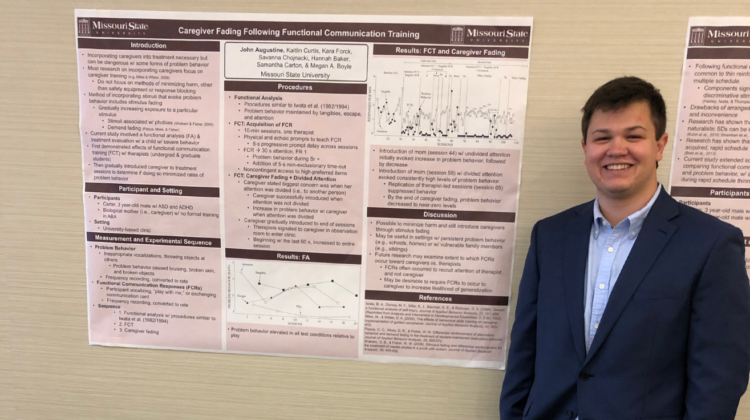
John Augustine stands near his research, displayed on a poster at a recent conference.

Missouri State University graduate student John Augustine grew up in the small town of Farmington, Missouri. There, he watched a role model—his own father—work as principal of an at-risk school.  

“He started his career as a special education teacher and later moved to administration,” Augustine said. “I specifically remember how connected he was to his students. He understood them, communicated effectively with them and provided them a positive educational experience.” 

His father made such an influence that Augustine found himself working with students in special education settings, too.  

“My father helped me understand how important it is to be a positive light in the classroom,” Augustine said.  

Augustine is now on track to receive a master’s degree in special education with an emphasis in autism spectrum disorders. Augustine’s pursuit of an additional autism spectrum disorders graduate certificate will bolster his expertise. 

“I love working in a school setting,” Augustine said. “My career goal is to consult schools and special education teachers to determine effective interventions for students with autism.” 

Real world practice 

Life as a graduate student at Missouri State gives Augustine just the experience he needs to follow in his father’s footsteps. On top of schoolwork, Augustine also works in an MSU-based clinic managed by Dr. Megan Boyle, associate professor of the counseling, leadership and special education department.  

At the clinic, Augustine takes on roles such as data-collector and therapist, implementing evidence-based practices to increase or decrease certain behaviors in students with autism.  

“Dr. Boyle does a great job in preparing students for their future in a clinical setting and teaching the importance of each task we complete,” Augustine said. “This is the type of job that requires you to learn. I hope to expand my knowledge to effectively implement strategies in my career.” 

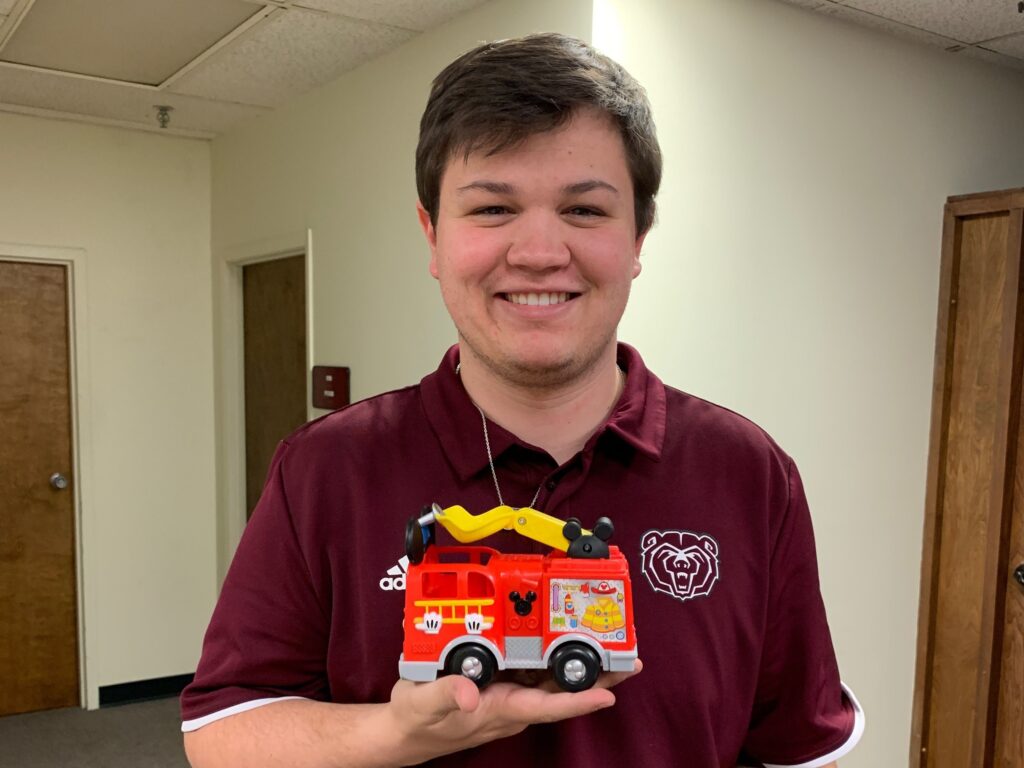
John Augustine holds a toy firetruck for students at the clinic.
Augustine holds a toy truck children interact with at the clinic.

Resume boost 

Learning experiences in Augustine’s program don’t stop there. Students are also granted the option to study Applied Behavior Analysis (ABA) and become a Board Certified Behavior Analyst (BCBA).  

Augustine said confirmation by the Behavior Analyst Certification Board will further enhance his resume.  

“If I’m able to accrue all my hours of study and pass a certification test, it will give me more opportunities to analyze data and make recommendations to improve target behaviors.” Augustine said. “I could change the lives of children with autism spectrum disorder or other disabilities.” 

Augustine is currently completing his thesis alongside Dr. Linda Garrison-Kane, another special education professor.  

“He has pursued numerous research and clinical opportunities during his undergraduate and graduate degree,” Garrison-Kane said. “His thesis focuses on the use of ICONNECT, a self-management technology application to assist in improving on-task academic behaviors in students with autism. 

Augustine hopes the technology will improve students’ academic accuracy across assignments. 

Empowered professional 

Augustine often thinks back on the role his father played in students’ lives.  

“Students who attended his school were in foster care or had been expelled from the other schools in the district,” Augustine said. “Although many did not have great home lives or a lot to look forward to, my father saw the capability of each student to progress in school and enjoy their education.” 

Augustine hopes to one day be as great of an influence.  

“I am trying to follow in his footsteps and create a better life for students—and maybe even one day change the world in some positive way.” 

Filed Under: COE Students Tagged With: autism spectrum disorders ceritificate, John Augustine, Linda Garrison-Kane, Megan Boyle, School of Special Education Leadership and Professional Studies, Special Education

« Previous Page

Categories

  • Bear POWER
  • Child Life Studies
  • COE Alumni
  • COE Faculty
  • COE Staff
  • COE Students
  • Counseling
  • Early Childhood and Family Development
  • Educational Administration
  • Elementary Education
  • Graduate Program
  • Literacy
  • Middle School Education
  • Secondary Education
  • Special Education
  • Student Affairs
  • Uncategorized

Archives

Meta

  • Log in
  • Entries feed
  • Comments feed
  • WordPress.org
  • Accessibility
  • Disclaimer
  • Disclosures
  • Equal Opportunity Employer and Institution
  • © 2026 Board of Governors, Missouri State University
  • Contact Information