Missouri State University

Skip to content Skip to navigation
a b c d e f g h i j k l m n o p q r s t u v w x y z

Health and Human Services News

  • McQueary College of Health and Human Services

Spreading their wings

December 15, 2023 by Strategic Communication

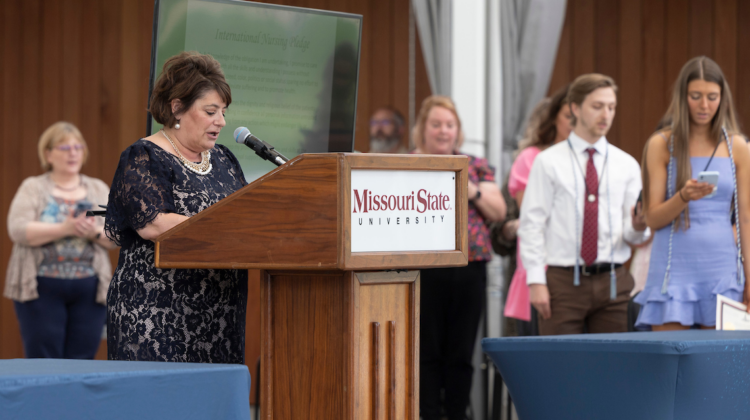
The nursing pinning ceremony

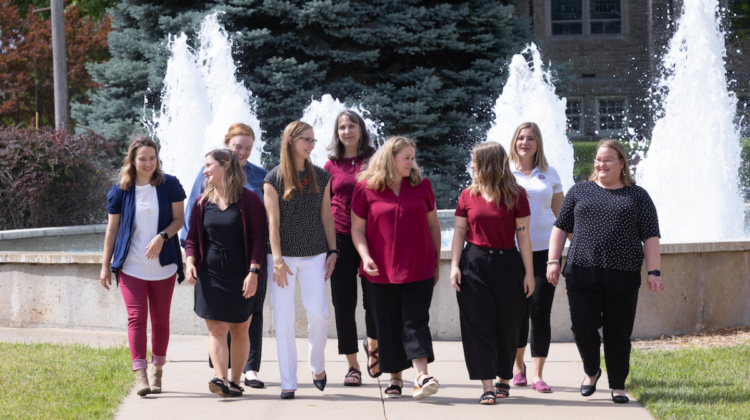
The McQueary College of Health and Human Services (MCHHS) is proud to announce that 135 students were hooded, pinned or received a white coat within a department or school ceremony for the fall 2023 semester. 

“These ceremonies are crucial in offering the space to celebrate MSU students who have worked hard to excel,” said MCHHS Dean Dr. Mark Smith. 

Students who were hooded or pinned will be graduating, while those who received a white coat will progress to clinical placements. 

Occupational therapy (OT) 

Twenty-five Master of OT students were hooded. 

Nursing 

Forty-five Bachelor of Science in Nursing students were pinned. 

Communication sciences and disorders 

Thirty-two speech-language pathology students were pinned. 

Physician assistant studies (PAS) 

Thirty-three PAS students received white coats. 
Filed Under: MCHHS Events, Nursing, Occupational Therapy, Physician Assistant Tagged With: commencement, Communication Sciences and Disorders, Mark Smith, Physician Assistant Studies, School of Nursing

Unveiling the latest research at the MOABA conference 

December 14, 2023 by Strategic Communication

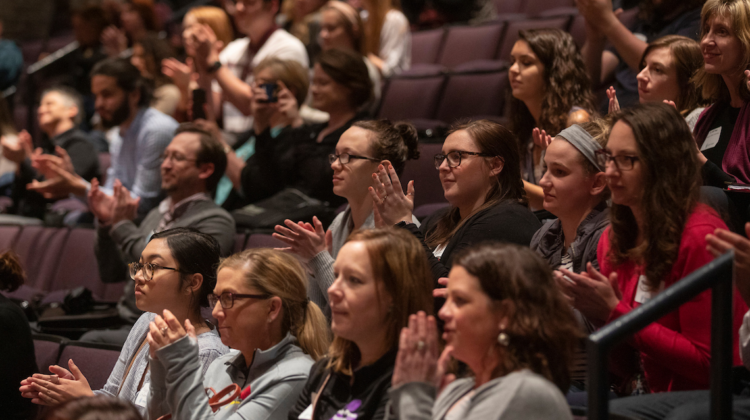
People clapping

Missouri State University students and faculty attended the annual Missouri Association for Behavior Analysis (MOABA) conference on Nov. 9-10 in St. Louis. 

Speakers were invited from all over the country to present at the conference on topics ranging from services for autistic learners to time and nutrition management. 

Dr. Jordan Belisle, president of MOABA and associate professor for the School of Mental Health and Behavioral Sciences, began his term as the organization’s president with the goal of expanding its scope and outreach to underserved communities.  

The Institute for Dynamic Behavior Science 

A total of 10 student posters were accepted to the conference from MSU by students in the Institute for Dynamic Behavior Science (IDBS).  

Belisle and Dana Paliliunas co-founded IDBS; it includes students from the Behavior Analysis and Therapy (BAT) program and the new Doctor of Psychology (PsyD) program.  

Posters presented at the conference 

A mix of BAT students, PsyD students and undergraduate student researchers from the undergraduate lab (BEAR Lab) participated in the research presented at the conference. 

“MOABA challenged my thoughts about the behavior analysis field. It helped me consider how I want to grow in behavior analysis and what contributions I hope to make as a professional,” said Katelyn Frahm, a first-year graduate student in the BAT program.  

“I loved seeing all the students and professionals come together for the common goal of serving others.” 

Poster topics included: 

  • Language and cognitive training for autistic children, presented by Frahm. 
  • Laboratory research on human cognition and behavior, presented by Amanda Middleton. 
  • Supporting unhoused people in the community, presented by Bentley Elliot. 
  • Willingness to engage with international students on campus. 
  • Values-based skills training for adults with disabilities. 

Four doctorate-level researchers who were also conference speakers judged the competition independently.

“All student presenters represented the institute and the department exceptionally well,” Belisle said. Attendees were incredibly enthusiastic about this work and its impact on the field of ABA and communities served.” 

Explore the school of mental health and behavioral sciences

Tagged With: MCHHS Spotlights, McQueary College of Health and Human Services, Psychology, students

Dispelling common advising myths

December 1, 2023 by Strategic Communication

Hillary Mayes, director of the MCHHS Student Success and Advisement Center (SSAC) and student success specialist, has encountered more than a few advising myths during her time here at Missouri State University.

The two biggest misconceptions Mayes has found are that advisors and advisement centers are only for students who are falling behind or for students who need help choosing their academic courses.

“The term ‘academic advisor’ is a bit of a misnomer since advisement is far more than simply helping students pick out academic courses,” she said.

The MCHHS SSAC team works hard to understand students’ unique needs and help them navigate their college experiences accordingly.

“We aim to help them connect to their programs and their program faculty in ways that will help them develop their professional interests and move closer to their professional goals,” Mayes said.

Myth

Advisement centers are only for struggling students.

Reality

Advisement centers and advising staff are here to help all students. In fact, Missouri State requires that all first- and second-year undergraduate students meet with an advisor before they can enroll in classes.

Advisors are a vital campus resource for students to help them navigate university policies, processes and procedures.

Myth

Advisors only help with course scheduling.

Reality

Although helping students create plans of study and selecting courses is an important part of the advisor/advisee relationship, it is not the only type of support provided. Advisors can often serve as a designated person on campus with whom students can feel comfortable having discussions; these discussions don’t always have to be academic in nature.

As student champions, advisors are here to celebrate with students when they are excited or to brainstorm with students if they feel conflicted. Advisors can assist with career and academic major exploration, connecting to relevant resources or offices and with personal or professional development.

Advisors also work closely with academic units and faculty, assist with marketing and recruitment, engage in professional development and provide service to the university through committee work.

Myth

Advisors can register students for their classes.

Reality

Because students are in charge of their academic experience, this responsibility resides exclusively with them. Although advisors are happy to discuss course options with students and make suggestions related to timing, course loads and modalities, students are the only ones who can register for their own classes.

Myth

Advisors provide mental health services.

Reality

This is a common misconception; the role of an advisor is often compared to the role of a counselor. Although advisors do support students and frequently discuss sensitive topics with them, they aren’t licensed mental health providers and can’t legally provide this service. If a student needs mental health services, we have wonderful resources available to them through our Counseling Center located in the Magers Health and Wellness Center.

Myth

Advisors hold appointments only when fall and spring classes are in session.

Reality

If university offices are open, staff advisors are on campus and available to meet with students. Advisors are 12-month employees, meaning they are available and willing to see students throughout all months of the year.

Explore the MCHHS Student Success and Advisement Center

Filed Under: Student Success and Advisement Tagged With: Hillary Mayes, MCHHS Student Success and Advisement Center, McQueary College of Health and Human Services

Dietetics student gives back

December 1, 2023 by Strategic Communication

People work at the Ozarks Food Harvest

KY3 recently featured Andrew Falk, exercise and movement science major, for his work at Ozarks Food Harvest (OFH).

Falk found OFH because he needed to fulfill the requirements in a dietetics class — a community engagement project that requires students to volunteer.

Watch the clip

The KY3 segment shows OFH prepping for the Thanksgiving season and Falk discusses his personal story; he’s found his volunteer efforts at OFH are a great way to give back and help “build a better community.”

“When I was a kid, we went through a hard time and had to go to pantries and stuff like that,” Falk said. “It feels like everything’s come full circle and it’s nice to give back.”

OFH serves over 270 different charities across 28 counties in the Ozarks, providing 1.5 to 2 million meals per month. They’re expected to spend an additional $500,000 on holiday meals this year.

Learn more about the exercise and movement science program

Filed Under: Uncategorized Tagged With: Dietetics, McQueary College of Health and Human Services

« Previous Page
Next Page »

Categories

Archives

Meta

  • Log in
  • Entries feed
  • Comments feed
  • WordPress.org
  • Accessibility
  • Disclaimer
  • Disclosures
  • Equal Opportunity Employer and Institution
  • © 2026 Board of Governors, Missouri State University
  • Contact Information