Missouri State University

Skip to content Skip to navigation
a b c d e f g h i j k l m n o p q r s t u v w x y z

Health and Human Services News

  • McQueary College of Health and Human Services

Bearing the banner at commencement

April 30, 2026 by Sewly Khatun

The procession of graduates from the McQueary College of Health and Human Services.

Some honors represent more than one achievement.  

They reflect years of leadership, growth and commitment to making every opportunity count. 

At the McQueary College of Health and Human Services (MCHHS), the Banner Bearer honor recognizes a student whose academic excellence, campus involvement and service make a lasting impact. 

“Serving as a Banner Bearer is a recognition reserved for students who exemplify Missouri State University’s highest ideals,” said Dr. Letitia White Minnis, MCHHS associate dean. “The role represents a student’s demonstrated commitment to the university’s public affairs mission of ethical leadership, community engagement and cultural competence.” 

Representing MCHHS at commencement 

Seven exceptional students were nominated for the honor this year: 

  • Carlos Abrams, senior, psychology 
  • Shawneva Daboz, senior, biomedical sciences 
  • Abigail Dunker, senior, health services  
  • Georgia Ehrhardt, senior, communication sciences and disorders, speech-language pathology pathway 
  • Allie German, senior, psychology  
  • Olivia Melder, senior, social work  
  • McKenzie Plummer, senior, communication sciences and disorders, audiology pathway  

From this group, German was chosen to carry the MCHHS banner and lead the procession for the college at the spring 2026 commencement ceremony at 1 p.m. May 8 in Great Southern Bank Arena. 

Reflecting on the honor 

Allie German
Allie German

For German, being selected as a Banner Bearer is a meaningful achievement and reflects her undergraduate journey.

She also expressed her gratitude to Dr. Amber Abernathy, professor and psychology undergraduate program director, for the nomination.  

“I spent my undergraduate years making the most of each course, participating in many extracurriculars and seeking experiences that pushed me out of my comfort zone,” German said. “Through these experiences, I became more involved on campus and got to know my professors and Missouri State peers better.” 

Abernathy praised German’s commitment to learning and leadership.  

“Over the past few years, I’ve watched Allie distinguish herself through research, campus leadership and academic excellence,” Abernathy said. “She approaches all projects with excitement and zeal for knowledge.” 

After graduation, German plans to continue her academic journey through Missouri State’s experimental psychology master’s program. 

“My long-term goal is to be an experimental psychologist and to spend a lifetime learning more,” German said. 
 

Explore MCHHS

Filed Under: audiology, MCHHS News, speech-language pathology Tagged With: Amber Abernathy, Biomedical Sciences, Communication Sciences and Disorders, health services, Letitia White-Minnis, Psychology

How experience shapes empathy

July 22, 2025 by Sewly Khatun

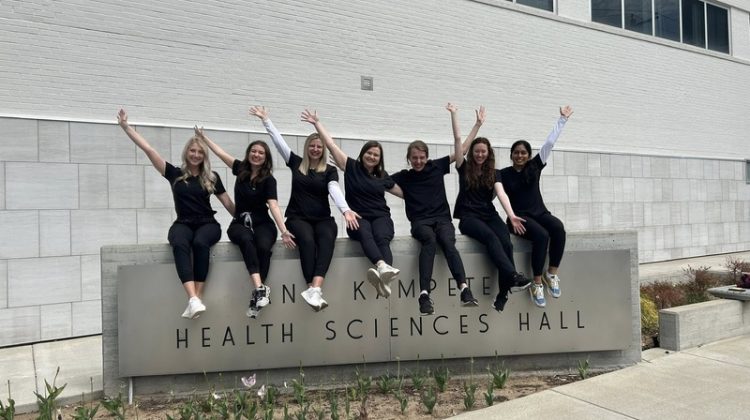
James Buechter (third from right) with his audiology cohort outside Kampeter Health Sciences Hall.

Since high school, Missouri State University Doctor of Audiology (AuD) student James Buechter has been set on pursuing a career in the audiology field. 

He is now getting closer to fulfilling his calling of helping others hear the world better. 

A personal connection   

James Buechter at his audiology research poster presentation.
James Buechter

After graduating from high school, Buechter, a native of St. Louis, completed two years of community college. He transferred to Missouri State in 2020 to finish his undergraduate degree in communication sciences and disorders. 

“I wanted to go somewhere with an AuD program and MSU made the transition to graduate school smooth,” he said. 

It was also the most affordable option, especially important since there are few programs like this in the state. 

Buechter’s lived experience with hearing aids and a cochlear implant has shaped how he views audiology. It helps him better connect with patients.  

“The benefits of audiology in my life are tangible,” he said. “It’s easy for me to understand what the patients are going through.” 

At Missouri State, he enjoys the small size of the audiology program. He feels fortunate to be part of a supportive cohort that has taught him empathy and strength in both clinical and personal settings. 

Buechter got to observe audiology appointments as an undergraduate and build early connections with faculty. He expressed gratitude for the support he received from his professors and peers. 

Buechter worked with different audiologists each semester and completed his clinical rotations in areas such as Columbia and Joplin, Missouri. 

“That variety gave me the confidence I needed to go into an externship,” he said. 

Learning in a deaf-centered environment 

Buechter is currently completing his clinical externship at the National Technical Institute for the Deaf (NTID) at Rochester Institute of Technology (RIT). NTID is the first and largest technological college in the world for deaf and hard-of-hearing students. 

It is Buechter’s first time in a completely deaf environment. 

“I didn’t grow up learning American Sign Language,” he said. “Here, deafness is seen as identity, not something medical.” 

He has learned that patient goals in this setting are often different from what he is used to. 

“The patient may or may not want to use hearing assistive technology,” he said. “His or her goals could focus on environmental awareness or music enjoyment but not include speech understanding.” 

James Buechter (third from right) at the 2025 White Coat Ceremony for Doctor of Audiology students.
James Buechter (third from right) at the 2025 White Coat Ceremony.

Besides helping with clinical services, Buechter is also learning through RIT campus life and conversations. 

One of his most memorable moments was a campus tour with co-workers, where he learned about NTID’s rich history. Some staff included NTID alumni who spoke with pride about former President Lyndon Johnson’s role in establishing the school and his support for the Civil Rights Act. 

One step at a time 

Buechter knew graduate school would be tough, but he stayed focused. He earned his white coat in April.  

He will graduate in spring 2026 and wants to continue his journey as a clinician.  

“I want to start my career in a diverse patient population setting,” he said. “I also care about policy and want to help shape a health care system that supports both patients and providers.” 

Explore Doctor of Audiology

Filed Under: Student spotlights Tagged With: Communication Sciences and Disorders, students

Exploring the art and science of dementia care

April 28, 2025 by Sewly Khatun

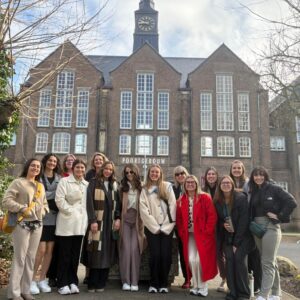
MSU students and faculty at the Netherlands Institute for Neuroscience.

Over the recent spring break, a group of Missouri State University students and faculty traveled to the Netherlands to explore a person-centered approach to aging and dementia care. 

From hands-on lectures to cultural tours, the program blended art, science and human connection – all inspired by the groundbreaking The Hogeweyk® Dementia Village near Amsterdam. 

An eye-opening experience 

The week-long interdisciplinary study abroad program took place from March 15-21. 

Jennifer Pratt, clinical professor of communication sciences and disorders (CSD), and Dr. Traci Garrison, clinical associate professor of occupational therapy (OT), led this program. 

Twelve undergraduate and graduate students from CSD, gerontology, health sciences, nursing and pre-OT participated in the program. They prepared through weekly pre-departure sessions, guided readings and guest lectures. 

The program itinerary blended academic lectures with cultural exploration. Pratt and Garrison expressed sincere gratitude to Missouri State’s office of education abroad and McQueary College of Health and Human Service for supporting and funding this program. 

“We designed this program to show students what’s possible,” said Pratt. “We wanted them to look at dementia not just through a medical lens, but through the lens of quality of life.” 

Students got the chance to visit the internationally recognized The Hogeweyk®. Unlike traditional institutional models, The Hogeweyk® empowers individuals with severe dementia to live as normally as possible in a secure community setting. Residents live in shared homes based on lifestyle interests, with access to grocery stores, cafés and open green spaces. Their focus is on living well, right until the end.

The Dutch model emphasizes that dignity, autonomy and well-being are just as essential as medical treatment – a philosophy that deeply resonated with students.  

“Learning through travel is just something the classroom cannot replicate,” said Pratt. 

A new perspective on care

MSU students explore historic Amsterdam during their education abroad experience.

According to Garrison, this study abroad program emphasized more than treatment.

“It encouraged students to consider how care environments can empower people to live fully, no matter their diagnosis.”

Students also learned from leading experts at the Leyden Academy on Vitality and Aging and Netherlands Institute for Neuroscience about the science behind dementia. At the institute, the group toured a brain bank and explored the latest dementia research, making classroom theories come alive. 

“We studied something we see every day, but in a completely new way. It challenged us to rethink traditional care approaches,” said Natalie Hampsten, a senior CSD major. “It opened my eyes to what care really looks like when you center it around people.” 

Abby Rudd, a senior gerontology major, was struck by The Hogeweyk’s® philosophy.  

“They taught us to focus on possibilities, not disabilities. That mindset changes everything,” she said. 

Besides the learning opportunities, the program offered cultural immersion. Students explored Amsterdam’s history through walking tours and visits to the Anne Frank House, Van Gogh Museum and Rijksmuseum. These experiences contributed historical and emotional depth to their academic exploration, encouraging empathy and reflection. 

“This was my first time studying abroad and visiting the Netherlands and it was amazing!” said Hannah Todd, a speech-language pathology graduate student. “What I enjoyed most was how the program blended Dutch culture with dementia care in such a meaningful way.” 

A focus on compassion and empathy 

For Karly Soden, a Doctor of Nursing Practice student, traveling to a new country, learning with new people and seeing dementia care through a global lens was an unforgettable experience.  

“It shifted my perspective of human connection and its importance in health care,” she said. 

In class or on the streets of Amsterdam, students learned that true care means honoring lives, not just managing symptoms. Their experiences brought theory to life and reshaped their understanding of compassion in practice. 

“Students didn’t just learn about dementia,” said Garrison. “They learned to think differently, lead with empathy and carry those values into their future careers.” 

Explore degree options in MCHHS

Filed Under: MCHHS News, speech-language pathology Tagged With: Communication Sciences and Disorders, Gerontology, Jennifer Pratt, Occupational Therapy, School of Health Sciences, School of Nursing, students, Traci Garrison

Faculty research on display

April 28, 2025 by Sewly Khatun

The Fountain in front of Meyer Library.

Research took the spotlight at Missouri State University on April 11. 

The Faculty Center for Teaching and Learning hosted its first-ever Spring Scholarship Summit in Meyer Library. Faculty members from various disciplines showcased their latest research and scholarly projects through interactive poster presentations.  

Over 20 presenters participated with 14 posters displayed. Attendees got to meet the presenters, explore new research ideas and engage in meaningful conversations.  

Ten faculty members from McQueary College of Health and Human Services (MCHHS) took part in the Spring Scholarship Summit. Five led poster presentations while the rest contributed as interdisciplinary co-authors. 

The summit underscored Missouri State’s continued commitment to teaching excellence and interdisciplinary collaboration.

Promoting trauma-informed care 

From the School of Nursing, Dr. Diane Smith, assistant professor, collaborated with Dr. Cindi Aurentz, assistant professor, and Dr. Melissa Penkalski, associate professor and graduate program director.

From left to right: Drs. Cindi Aurentz, Melissa Penkalski and Diane Smith.

Together, they presented “Trauma-Informed Education for Nursing Faculty: Caring for the Next Generation of Nurses.”    

The team began the project in 2021, aiming to help faculty use trauma-informed care training to better support students both in classrooms and clinical settings.

“We welcome every opportunity to share the principles of trauma-informed care, as this is a topic we all care deeply about,” Smith said. “We hope these practices are integrated.” 

Fostering interprofessional collaboration 

From left to right- Natalie Allen, Bonnie Slavych, Wendy Jackson, and Traci Garrison.
From left to right: Natalie Allen, Dr. Bonnie Slavych, Wendy Jackson and Dr. Traci Garrison.

Registered dietitian Natalie Allen is a clinical associate professor of nutrition and dietetics. She presented “Emphasizing Interprofessional Education Through a Virtual Case Study Connecting Healthcare Students” alongside her colleagues as part of ongoing interprofessional collaboration. 

Allen and three other faculty members from multiple disciplines worked together on this project. They included: Dr. Traci Garrison, clinical associate professor in the School of Health Care Professions; Wendy Jackson, clinical assistant professor in the School of Mental Health and Behavioral Sciences; and Dr. Bonnie Slavych, assistant professor in communication sciences and disorders.

Their poster explored how virtual case studies can strengthen interprofessional collaboration in health care education.  

The study brought together students from different majors to build teamwork, communication and decision-making skills in an online setting. It also helped them understand each other’s roles and practice collaborative contribution to patient-centered care in real-world environments. 

“The summit was a great opportunity to promote interprofessional collaboration and show the value of connecting different disciplines,” Allen said. “This project helped all of our students gain the skills and confidence they need before stepping into real-world practice.” 

Focusing on resilience 

Dr. Debbie Horine, assistant professor in the School of Nursing, presented “Introducing Resilience to Pre-Licensure Nursing Students to Recognize and Address Lateral Violence.”

From left to right- Cindi Aurentz, Kristen Thompson, Sara Wilson, and Diane Smith.
From left to right: Drs. Cindi Aurentz, Kristen Thompson, Sara Wilson and Diane Smith.

Her project focused on preparing nursing students to recognize workplace challenges and strengthen emotional resilience early in their careers. 

“While we can’t eliminate lateral violence, we can prepare students to recognize it, build resilience and manage stress,” Horine said. 

Dr. Sara Wilson and Dr. Kristen Thompson, both assistant professors in the School of Mental Health and Behavioral Sciences, co-presented two posters: 

  • “The Impact of Adverse Childhood Experiences in Higher Education” 
  • “Combating Loneliness Through Intergenerational Living Communities” 

The first study examined how early trauma affects college students’ academic performance and mental health. The second study focused more broadly on community well-being, exploring how intergenerational housing can reduce isolation and foster connection. 

Together, the research underscores the importance of trauma-informed practices and community-based solutions that strengthen resilience and belonging. 

“I’m driven to explore how we can support positive outcomes right here on our campus and in our communities,” Wilson said. 

Explore degree options in MCHHS

Filed Under: MCHHS News Tagged With: Bonnie Slavych, Cindi Aurentz, Communication Sciences and Disorders, Debbie Horine, Diane Smith, faculty, Kristen Thompson, Melissa Penkalski, Natalie Allen, Nutrition and Dietetics, research, Sara Wilson, School of Health Care Professions, School of Mental Health and Behavioral Sciences, School of Nursing, Traci Garrison, Wendy Jackson

Next Page »

Categories

Archives

Meta

  • Log in
  • Entries feed
  • Comments feed
  • WordPress.org
  • Accessibility
  • Disclaimer
  • Disclosures
  • Equal Opportunity Employer and Institution
  • © 2026 Board of Governors, Missouri State University
  • Contact Information

Loading Comments...