Missouri State University

Skip to content Skip to navigation
a b c d e f g h i j k l m n o p q r s t u v w x y z

Health and Human Services News

  • McQueary College of Health and Human Services

From launch to milestone

May 8, 2026 by Ella Reuter

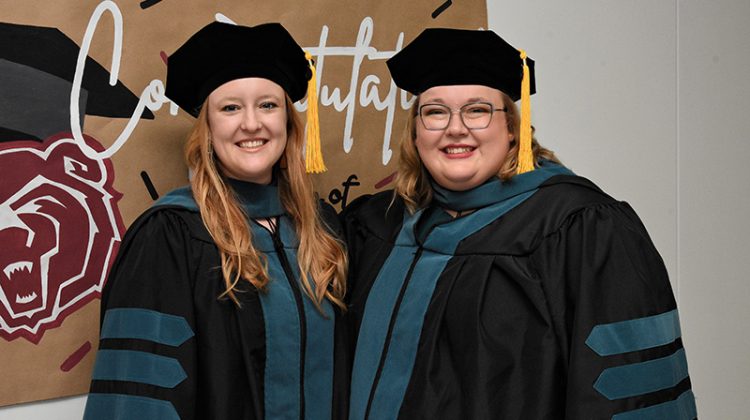
Ellie Murphy (left) and Caitlan Schasteen (right).

Launched in 2023, Missouri State University’s Postprofessional Doctor of Occupational Therapy (PP-OTD) program celebrates its first two graduates this May: Caitlan Schasteen and Ellie Murphy.

The duo also received their Master of Occupational Therapy (MOT) from Missouri State.

According to PP-OTD director Dr. Sapna Chakraborty, the program was designed “with our alumni in mind, providing a pathway for practitioners with a master’s degree to return, advance their education and expand their career opportunities.”

She added that the program’s first two graduates represent “years of intentional planning, persistence and growth.”

Schasteen
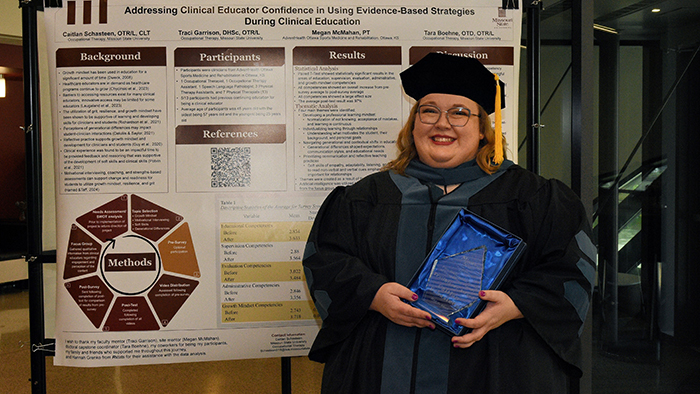
Schasteen with her research presentation for the 2026 Einhellig Interdisciplinary Forum on campus.

From Paola, Kansas, Schasteen received her bachelor’s degree in child and family development and MOT in May 2017 and 2019, respectively. She can now add a doctorate to her list of credentials.

She pursued OT to help people “find what was meaningful to them and get back to that.”

Being part of the inaugural program was a valuable experience.

“I knew all my professors from my master’s, and they were all very open to learning and trying new things. They were willing to take our feedback and talk to us about changes in the future,” said Schasteen, who works as an occupational therapist at AdventHealth in Ottawa, Kansas.

One of the program’s highlights was the capstone project. Schasteen created four videos on topics educators wanted more information on, such as growth mindset, motivational interviewing, soft skills and generational differences. She did the project at AdventHealth, using coworkers to test the content.

Her favorite part about her time at Missouri State has been the people she has met. She is grateful for her capstone project mentor, Dr. Traci Garrison, a clinical associate professor in the School of Health Care Professions.

“Whether I go into academics or continue clinical work, those relationships will still be there for me,” Schasteen said.

Murphy
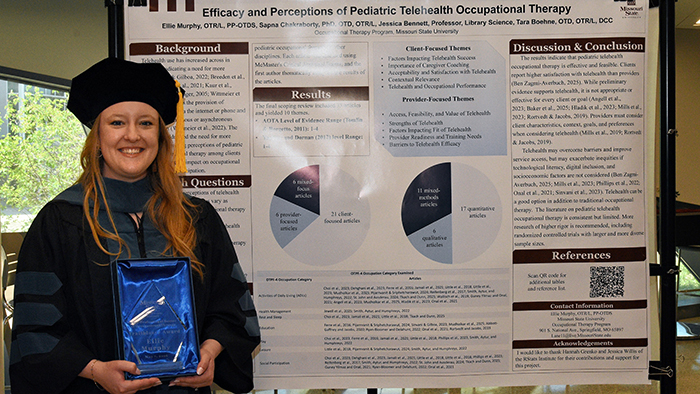
Murphy with her research presentation for the 2026 Einhellig Interdisciplinary Forum on campus.

Originally from Pleasant Hope, Missouri, Murphy played softball and earned her bachelor’s degree in allied health from Evangel University. She decided to pursue the MOT at Missouri State in 2020.

“I’d heard great things from people who had completed their master’s here, so I decided to take the leap and pursue the program myself,” Murphy said.

After completing her master’s in 2022, she continued with the PP-OTD.

“I already knew the professors and trusted them and their professional judgement. I knew I’d get a good education here,” Murphy said.

She chose OT because it is a broad field.

“You can do a lot of things within OT. You also get to mix creativity and science and help a wide range of people in many different ways,” she said.

She credits the program for preparing her further for real-world practice.

“It gave me a great opportunity to integrate my previous professional knowledge and experiences into the new learning I gained in the program,” Murphy said.

For her capstone project, she completed a scoping review about pediatric telehealth, which is an area she currently works in. She studied its efficacy and outcomes, as well as parent, client and provider perceptions.

Murphy is honored to be one of the first two graduates of the PP-OTD program.

“I’m excited I got to be part of building the program from the ground up. I love the OT department at Missouri State,” she said.

What comes next

Schasteen plans to continue working at AdventHealth. She will also take on some clinical students on their fieldwork rotations this summer and fall to apply what she has learned.

She dreams of becoming a professor and teaching occupational therapy. Completing the PP-OTD degree will help her reach that goal.

As for Murphy, her short-term plan is to keep working in pediatric telehealth, PRN at Mercy Hospital, and at the Missouri State Occupational Therapy Clinic.

For the future, she wants to work in OT education and conduct research to expand the profession’s knowledge base.

Learn more about the PP-OTD program

Filed Under: MCHHS Alumni, Student spotlights Tagged With: Alumni, faculty, Master of Occupational Therapy, Occupational Therapy, PP-OTD, Sapna Chakraborty

Where passion meets practice

April 23, 2026 by Sewly Khatun

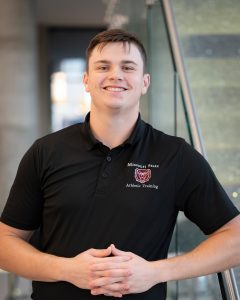
Athletic training students practice emergency injury response during a hands-on simulation exercise.

A single moment on the field or court can change everything. When an athlete goes down, time slows and someone must be ready, not just with skill, but with calmness, confidence and the instinct to act. 

For Missouri State University graduate students Cooper Lewis and Malia Moore, that moment is not hypothetical — it is the reason they chose the athletic training path. 

Both are in the Master of Athletic Training program at Missouri State and will graduate this spring. Through their time at the university, they have found their purpose by combining a love for sports with a drive to help others. 

Finding the calling

Malia Moore
Malia Moore

Moore grew up in Liberty, Missouri, just outside Kansas City. Her path to athletic training began through personal experience. 

“I played soccer in high school and suffered from an injury,” she said. “I saw what athletic trainers did firsthand and knew this was something I wanted to do in future.” 

While exploring programs across Missouri, Moore was drawn to Missouri State’s strong reputation and felt the Springfield location was the right fit. She began her bachelor’s degree in sports medicine in fall 2020 and, after graduating in May 2024, continued on to pursue her master’s. 

As for Lewis who grew up in Laredo, Missouri, he came to the field through a different way. A lifelong sports enthusiast, he spent years searching for a career that included everything he cared about: athletics, health and helping people. Athletic training brought those pieces together. 

“I loved sports my entire life and wanted a career that could combine my interests,” he said. “Once I discovered athletic training, the rest was history.” 

Lewis chose Missouri State for its high-quality program and supportive learning environment. He also valued the opportunity to complete both his undergraduate degree in sports medicine and graduate degrees in one place, building his clinical foundation from the ground up. 

Learning that extends beyond the classroom 

The duo began their master’s program in summer 2024. They found a curriculum that places students in real clinical environments early and often. They got to work alongside athletes, preceptors and health care professionals in ways textbooks alone cannot replicate. 

“I thought I wouldn’t like any setting other than high school. But I fell in love with the college environment, which I didn’t expect,” Moore said. 

Cooper Lewis
Cooper Lewis

Lewis credits the program for turning him into a professional.  

“The relationships made the biggest impact on my life,” he said. “I’ve enjoyed and developed friendships with classmates, professors, preceptors, athletes and patients.”  

Both students also stepped into research and leadership. Lewis is completing a critically appraised topic research study on dry needling and its effects on chronic tendinopathy injuries. He also serves as president of the Athletic Training Student Association.  

Moore worked on a research project that focused on the effectiveness of dry needling on hamstring strength, range of motion, pain and extensibility. She presented it at the recent McQueary College of Health and Human Services Student Research Symposium. 

An experience that stands out for both of them was traveling with Missouri State Football to its first-ever bowl game, the Xbox Bowl in Frisco, Texas, last December. They enjoyed experiencing a major athletic event. 

“It was such a fun experience and one of my favorite memories,” Moore said.  

Lewis echoes that feeling and described it as an opportunity to build strong connections while working alongside fellow students and professionals. 

What comes next 

With graduation coming up, the students are already clear on their next steps and purpose. 

Moore wants to work in college athletics, building the same kind of relationships with athletes she experienced with her own athletic trainers, including assistant professor Dr. McCall Christan.  

“I hope to help athletes stay healthy, recover from injuries and perform at their best,” she said. “As a former injured athlete, I know the value of having someone steady in your corner.” 

Lewis is interested in rehabilitation and clinical care, with long-term goals in health system leadership. In a profession often misunderstood or overlooked, that kind of advocacy matters and begins with practitioners who believe in the work. 

“I want to continue to advocate for athletic trainers and increase public knowledge of what we do,” he said.  

For Lewis and Moore, athletic training is more than a career path. It is about being present in critical moments, building trust with patients and using knowledge and compassion to help them return stronger. 

Learn more about the athletic training program

Filed Under: Student spotlights Tagged With: Athletic training, Public health and sports medicine, students

A future psychologist in the making

April 13, 2026 by Ella Reuter

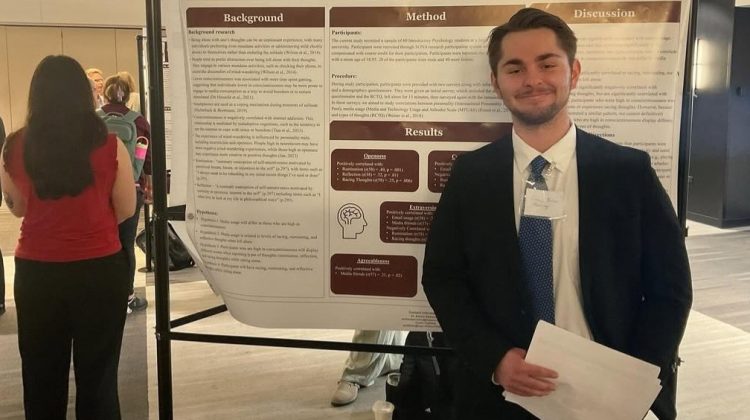
Chance Barber presents his research.

Chance Barber wants to make a difference where it matters most: people’s lives.

As the Missouri State University senior prepares to graduate in May with a bachelor’s degree in psychology, he is one step closer to becoming a psychologist.

“I grew up around Missouri State’s campus, so it’s crazy that not long ago, I was 10 years old looking up to the same kind of hardworking, intelligent individuals I’m now around every day,” Barber said. “It’s been an honor to develop personally and professionally in this environment.”

Finding his way at Mo State

When Barber, who is from Republic, Missouri, began his studies at Missouri State in August 2022, he was undecided on a major.

“I wasn’t 100% set on what I wanted to do yet, but Missouri State was a great place to keep my options open while also having the opportunity to explore specific interests,” he said.

When he finally committed to vocational psychology, it was inspired by his experiences during the COVID-19 pandemic and the chaos it caused.

“Just seeing people struggle through work-related challenges in different areas of my life fueled my drive to see where I could help,” Barber said.

Vocational psychology explores how mental health connects to a person’s work and career development. He is especially interested in how it addresses questions like, “What do you want to do when you grow up?”  and “Does the work I do really matter?”

Barber credits Missouri State for giving him a good mix of hands-on and research experiences that helped him learn and grow.

In 2024, he attended the Society for Industrial and Organizational Psychologists conference in Chicago, Illinois. There, he got to learn from the presentations of peers and professors.

Last year, he presented his research about personality and media usage habits and how they are related to cognition quantity and quality at the McQueary College of Health and Human Sciences Student Research Symposium on campus, as well as the Midwestern Psychological Association’s annual conference in Chicago. Later this month, he will return there to present again.

Barber has also had the opportunity under Dr. Amber Abernathy, professor in the School of Mental Health and Behavior Sciences, and as a part of her S.O.C.I.A.L (stress, observation, conscientiousness, investigation and attitudinal learning) norms lab to conduct research and present the team’s findings.

Getting involved in other ways

Outside of the classroom, Barber maximized his college experience by participating in student organizations and taking on leadership roles.

Chance Barber in SHRM
Chance Barber (front row, far right) with fellow SHRM members.

Since his sophomore year, he has been active in the Society for Human Resource Management (SHRM) student chapter, becoming vice president his junior year. SHRM is a professional organization for people working in or studying human resources.

During his time as vice president, membership tripled and he supported students in exploring opportunities around Springfield.

“I got to rub shoulders and work with a lot of great student leaders during my time in SHRM,” Barber said.

Last year, the chapter won the prestigious SHRM Superior Merit Award. It honors the chapter for excellence in operations and for delivering meaningful programs and services to members and HR students.

Barber is also currently the Psychology Club treasurer, a role he has held since April 2025. These organizations enabled him to make valuable connections, expand his network and grow both personally and professionally.

“Iron sharpens iron, so when you’re in that kind of environment, you really only have one choice: to improve,” he said.

After graduation, he plans to pursue a PhD in Counseling Psychology at the University of Southern Mississippi. There, he will work as part of Dr. Emily Yowell’s Vocational Psychology Research Team.

Be open

Barber encourages students to take time to connect with people around them and embrace opportunities.

“Be open to new opportunities even if you don’t feel qualified, prepared or experienced enough,” he said. “Give yourself time to learn and grow – that’s what college is for.”

Learn more about psychology

Filed Under: Student spotlights Tagged With: Psychology, School of Mental Health and Behavioral Sciences, students

A journey beyond limits

March 10, 2026 by Sewly Khatun

Madhusudan Ghimire

For many international students, moving abroad can feel overwhelming. Leaving home and starting over in a new country test even the most confident person.   

Missouri State University counseling graduate student Madhusudan Ghimire knows this firsthand. His journey shows how resilience can grow from life’s hardest moments.  

Though he once felt alone, he learned to turn that experience into a sense purpose, one that began long before Missouri State became part of his story. 

Overcoming a tough childhood 

Born with a visual impairment in a remote village in western Nepal, Ghimire spent his early years there before his family moved to Kathmandu when he was two. His parents relocated the family so he could attend school and access better opportunities. 

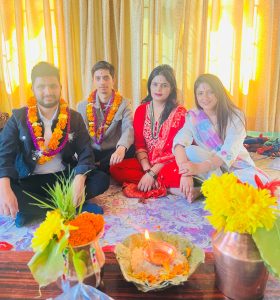
Ghimire with his sisters and cousins at a family program.
Ghimire (left) with his sisters and cousins at a family program.

But school was not always easy for Ghimire. Inclusive education was limited in Nepal, and his parents had to find a school where he could learn using braille. Even then, he felt lonely. 

“I used to experience isolation and had very few friends,” he said. “Most of the time, I was by myself. While other students played soccer or gathered with friends, I often stayed on the sidelines.” 

Social activities were difficult and classmates usually did not know how to interact with him. During those years, his siblings became his closest companions. His younger sister especially helped him through moments of loneliness.  

One experience in middle school stayed with him for years.  

In Nepal, students must ask permission before entering a classroom if a teacher is already inside. One day in seventh grade, Ghimire walked into a classroom without realizing the teacher was there. Because of his visual impairment, he could not see where she was standing among some of the students. The teacher reacted harshly, pulling his hair and forcing him out of the classroom.   

“That incident made me think about who I am and what I need to do in my life,” he said.  

The moment was painful, but it pushed him to reflect on his future. 

Finding a voice through literature and radio 

Madhusudan Ghimire
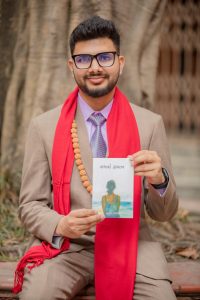
Ghimire’s first poetry book, “Mayako Aayatan.”

During those difficult years, Ghimire found comfort in listening to radio programs featuring poetry, storytelling and literature.  

“Radio programs inspired me to begin writing and literature became an important part of my life, helping me express myself and fill emotional gaps,” he said. “Those broadcasts became a quiet escape when I felt isolated.”  

Reading soon became a passion as well. In high school, he immersed himself in Nepali literature and once read more than 150 novels in a single year. Writing helped him process emotions and express experiences that were difficult to share in other ways. In 2024, he published his first poetry collection, “Mayako Aayatan” (Volume of Love).  

He also hosted a poetry-focused radio program for more than three years during his undergraduate studies in Nepal. Listeners often wrote to him about their personal struggles and emotional challenges.  

“People would share their feelings with me. Sometimes they just needed someone to listen,” he said. 

Those conversations gradually sparked his interest in mental health. 

Global experiences that shaped his path 

Technology also opened new doors for Ghimire. His older brother introduced him to screen reading software that enables blind users to navigate computers through audio feedback.   

“I was amazed when the computer started reading the screen,” he said. “I quickly learned how assistive technology worked and began helping others install accessibility tools.”  

However, not everyone believed in his potential. After he struggled early in class, his computer teacher made him take economics as an elective instead of computer studies. For Ghimire, the experience shook his confidence and affected his self-esteem.   

Despite the setback, he continued learning. Even with limited resources, he explored technology outside the classroom, driven by his interest in computers. That passion eventually led him to represent Nepal on the international stage.   

In 2017, he traveled to Hanoi, Vietnam, to compete in the Global IT Challenge for Youth with Disabilities. It was also his first time traveling abroad.  

“Before 2017, I had never traveled outside my country or even taken a plane. The first time I flew, it was to leave Nepal. I still remember how big that felt for me,” he said. 

After Vietnam, he attended similar events in India and South Korea before COVID-19. Those experiences built his confidence and strengthened his commitment to support young people with disabilities worldwide.

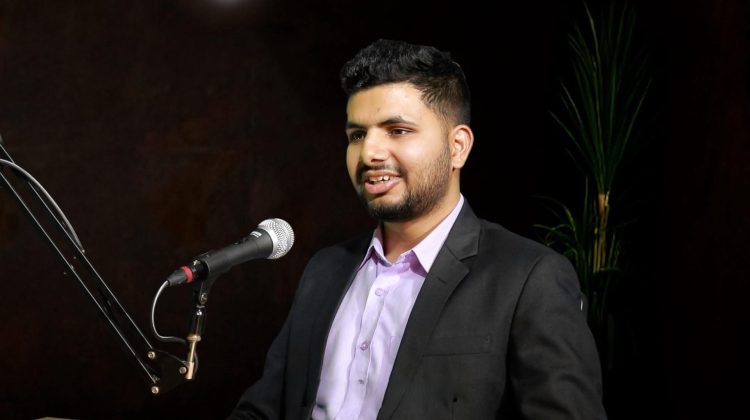
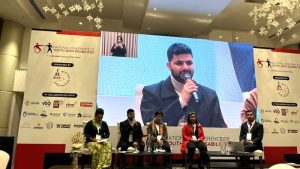
Madhusudan Ghimire speaks as a panelist on SRHR and access to mental health services at the National Conference of Youth with Disabilities.
Ghimire speaks as a panelist on access to mental health services at the National Conference of Youth with Disabilities.

Journey to Mo State 

Ghimire first came to Missouri State in spring 2023 through the Global Undergraduate Exchange Program. It is a Fulbright-supported initiative that brings international students to the United States for a semester of study. Only two students from Nepal were selected that year and Ghimire was one of them. 

After returning to Nepal, he finished his undergraduate degree in psychology. His work took a new direction in 2024, when he served as a psychosocial counselor in integrated schools through the United Kingdom-funded Nepal Earthquake Recovery project in partnership with the Blind Youth Association. Then, in 2025, he received the Fulbright Innovation Fund Award to launch a YouTube podcast on mental health and disability awareness. The 10-episode series focused on mental health and personal stories.  

This spring, he returned to Missouri State to pursue a master’s degree in counseling. He also works as a graduate assistant in Global Education and Engagement, where he helps exchange students adjust to campus life and supports digital accessibility initiatives. 

“Missouri State University is committed to creating a supportive and accessible environment for every student,” said Daezia Smith, leadership programs specialist in Global Education and Engagement. “In our office, Madhusudan helps us to recognize where our materials could be more accessible so we can better serve and reach a wider population.” 

According to Ghimire, Missouri State resources have played a key role in his success. The Disability Resource Center provides accommodations, such as accessible materials and extended testing time.  

“My supervisor, Kevin James, has been very supportive since the day I arrived here,” he said. “The office provided a mobility and orientation instructor, who helped me learn how to navigate campus, my house and offices using BearLine routes.” 

Experience in the counseling program 

So far, Ghimire has had a positive experience in his program and he appreciates the helpful faculty. As a new student, he is still adjusting to campus life and building friendships. Some parts of the counseling training can be challenging, especially lab sessions where students practice counseling with classmates. 

“Sometimes the cultural differences make it difficult because people talk about family or personal issues in ways that feel new to me,” he said. “But it’s helping me learn how support should reflect culture, background and lived experience.” 

As he thinks about his future, Ghimire hopes to combine counseling, disability advocacy and literature in his work. His earlier isolation and challenges now fuel his purpose: helping people facing emotional struggles feel heard, supported and less alone. 

Learn more about the counseling graduate program

Filed Under: Student spotlights Tagged With: Counseling, School of Mental Health and Behavioral Sciences, students

« Previous Page
Next Page »

Categories

Archives

Meta

  • Log in
  • Entries feed
  • Comments feed
  • WordPress.org
  • Accessibility
  • Disclaimer
  • Disclosures
  • Equal Opportunity Employer and Institution
  • © 2026 Board of Governors, Missouri State University
  • Contact Information

Loading Comments...