Missouri State University

Skip to content Skip to navigation
a b c d e f g h i j k l m n o p q r s t u v w x y z

Health and Human Services News

  • McQueary College of Health and Human Services

How RStats turns data into direction

August 20, 2025 by Sewly Khatun

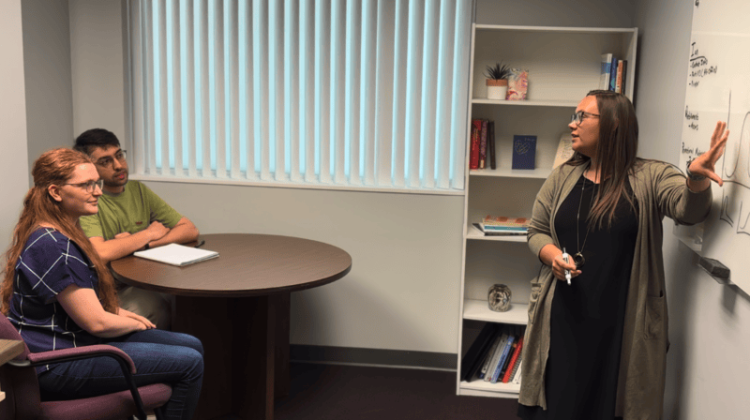
Jessica Willis demonstrates data analysis techniques during an RStats session.

Research can feel overwhelming when you don’t know where to start. 

That’s why the RStats Institute within the McQueary College of Health and Human Services (MCHHS) exists — to make the process easier, less intimidating and even enjoyable. 

Here, students and faculty work with experts who guide them with clear directions, simple tools and steady support. 

Guiding research at every stage 

The RStats Institute is a free resource dedicated to supporting faculty and students in MCHHS.  

Services include choosing the right design, finding the best measures, selecting proper statistical tests, developing surveys, collecting data and analyzing them using software like JASP, SPSS and Qualtrics. 

“We want students and faculty to feel confident at every step,” said RStats Director Jessica Willis. “Whether they’re designing research or interpreting complex results, we’re here to make the process easier.” 

Most support goes to graduate students working on capstone projects, theses or community-based research. Faculty can also receive help, usually up to three hours per project. 

A history of growth 

The RStats story began in the early 2000s, when Dr. Chantal Levesque, professor in psychology from 2002-2012, and Dr. Wayne Mitchell, faculty emeritus, started helping colleagues with statistical needs.  

They joined forces with the Ozarks Public Health Institute and Dr. Frederick Maxwell, faculty emeritus, to propose a dedicated consulting center. In 2006-07, RStats officially launched within MCHHS.  

During COVID-19, RStats expanded through online consultations, connecting students and faculty from more than 15 programs. Over time, it has grown from basic support to a full-service research hub. 

From student to RStats leader

Jessica Willis
Jessica Willis

A proud Missouri State alumna, Willis earned her bachelor’s and master’s degrees in psychology in 2015 and 2017, respectively. She also holds a graduate certificate in statistics and research design.  

Before joining RStats, she worked as a health care data analyst for the Missouri Primary Care Association. 

She joined RStats in September 2018 as coordinator and was promoted to director on July 1, 2024. Since then, her focus has shifted more toward overseeing RStats while still teaching ANE 700 each fall. 

In recent years, Dr. Caitlin Masterson, assistant professor in the School of Health Care Professions joined the team to teach research and statistics courses while also providing RStats consultation support. 

Together with two graduate assistants, they form the core team supporting RStats clients. 

The impact in action 

RStats doesn’t just ‘do the stats.’ It teaches students how to use them. They learn to run analyses, interpret their findings and share results with confidence. 

“Toward the end of the project, we often see that ‘light bulb’ moment where everything clicks,” Willis said. “They make the connection between theory and practice, and their learning goes beyond just the classroom.” 

Willis shared an example of a project led by Dr. Ashlea Cardin, professor and Master of Occupational Therapy program director.  

She and a few of her OT students studied 150 infants in the Neonatal Intensive Care Unit at Mercy Hospital to understand factors affecting hospital stay and oral feeding progress.  

RStats handled the data analysis, explained the results and assisted in the publication process. The study was published in the Journal of Neonatal Nursing in 2023, a big accomplishment for the team involved. 

“What made this project so impactful was how it showed students the real-world relevance of research and statistics,” Willis said. 

Explore RStats Institute

Filed Under: Staff spotlights Tagged With: Jessica Willis, Ozarks Public Health Institute, Psychology, research, RStats Institute, School of Health Care Professions, staff

Welcome new faculty and staff 

August 18, 2025 by Sewly Khatun

This year, McQueary College of Health and Human Services (MCHHS) welcomed 36 new faculty and staff members.  

“We’re thrilled they’ve chosen to share their talent, expertise and passion for teaching, research and service with our community,” said Dr. Letitia White Minnis, associate dean of MCHHS.

“At MCHHS, your success is our focus. Welcome aboard! We can’t wait to see the positive impact you all will make in the months and years ahead.”  

Who they are 

The new faculty and staff are joining various schools and departments in MCHHS:  

School of Anesthesia  

  • Mary Cherry (assistant to the program director) 
  • Savannah Clark (clinical assistant professor)  
  • Tashiana Conklin (admissions coordinator-academic advisor) 

School of Health Care Professions  

  • Dr. Emily Millard (clinical assistant professor)  
  • Miranda Myrick (clinical assistant professor) 
  • Tarah Trokey (assistant professor)  
  • Michael Rider (practitioner-in-residence) 

School of Health Sciences  

  • Funmilayo Adeshakin (instructor)  
  • Chang Hoon Lee (assistant professor)  
  • Shannon Crosby (clinical instructor)  
  • Taylor Dinyer-McNeely (assistant professor)  
  • Karla Riley (academic administrative assistant) 
  • Mackinsey Shahan (assistant professor)  

School of Mental Health and Behavioral Sciences  

  • Dr. J. Camille Hall (school director)  
  • Takudzwa Chawota (assistant professor)  
  • Wesley Church (associate professor)  
  • Michelle Durham (assistant professor)  
  • Aysegul Ercevik (assistant professor)  
  • Lauren Hembree (center city counseling director) 
  • Chelsea Krueger (assistant professor)  
  • Precious Mseba (assistant professor) 

School of Nursing  

  • Amy Anderson (clinical assistant professor)  
  • Mallory Covington (clinical assistant professor)  
  • Kalene Jochems (clinical assistant professor)  
  • Sheila Luttrull (clinical assistant professor)  
  • Melissa Moore (clinical assistant professor)  
  • Sarah Rinaldi (clinical assistant professor)  
  • Shauna Romine (clinical assistant professor)  
  • Vanessa Taylor (clinical assistant professor)  
  • Hailey Wecker (clinical assistant professor)    
  • Dedee Culley (clinical instructor)  

Ozarks Public Health Institute 

  • Siva Linga Prasad Cherukuri (data manager) 
  • Traci Nash (Community Focus facilitator) 

Student Success and Advisement Center 

  • Sara Bajalan (academic advisor) 
  • Sharon Harter (academic advisor) 
  • Tia Schneider (administrative specialist) 

Explore MCHHS

Filed Under: MCHHS News Tagged With: faculty, Letitia White-Minnis, MCHHS Student Success and Advisement Center, School of Anesthesia, School of Health Care Professions, School of Health Sciences, School of Mental Health and Behavioral Sciences, staff

Faculty research on display

April 28, 2025 by Sewly Khatun

The Fountain in front of Meyer Library.

Research took the spotlight at Missouri State University on April 11. 

The Faculty Center for Teaching and Learning hosted its first-ever Spring Scholarship Summit in Meyer Library. Faculty members from various disciplines showcased their latest research and scholarly projects through interactive poster presentations.  

Over 20 presenters participated with 14 posters displayed. Attendees got to meet the presenters, explore new research ideas and engage in meaningful conversations.  

Ten faculty members from McQueary College of Health and Human Services (MCHHS) took part in the Spring Scholarship Summit. Five led poster presentations while the rest contributed as interdisciplinary co-authors. 

The summit underscored Missouri State’s continued commitment to teaching excellence and interdisciplinary collaboration.

Promoting trauma-informed care 

From the School of Nursing, Dr. Diane Smith, assistant professor, collaborated with Dr. Cindi Aurentz, assistant professor, and Dr. Melissa Penkalski, associate professor and graduate program director.

From left to right: Drs. Cindi Aurentz, Melissa Penkalski and Diane Smith.

Together, they presented “Trauma-Informed Education for Nursing Faculty: Caring for the Next Generation of Nurses.”    

The team began the project in 2021, aiming to help faculty use trauma-informed care training to better support students both in classrooms and clinical settings.

“We welcome every opportunity to share the principles of trauma-informed care, as this is a topic we all care deeply about,” Smith said. “We hope these practices are integrated.” 

Fostering interprofessional collaboration 

From left to right- Natalie Allen, Bonnie Slavych, Wendy Jackson, and Traci Garrison.
From left to right: Natalie Allen, Dr. Bonnie Slavych, Wendy Jackson and Dr. Traci Garrison.

Registered dietitian Natalie Allen is a clinical associate professor of nutrition and dietetics. She presented “Emphasizing Interprofessional Education Through a Virtual Case Study Connecting Healthcare Students” alongside her colleagues as part of ongoing interprofessional collaboration. 

Allen and three other faculty members from multiple disciplines worked together on this project. They included: Dr. Traci Garrison, clinical associate professor in the School of Health Care Professions; Wendy Jackson, clinical assistant professor in the School of Mental Health and Behavioral Sciences; and Dr. Bonnie Slavych, assistant professor in communication sciences and disorders.

Their poster explored how virtual case studies can strengthen interprofessional collaboration in health care education.  

The study brought together students from different majors to build teamwork, communication and decision-making skills in an online setting. It also helped them understand each other’s roles and practice collaborative contribution to patient-centered care in real-world environments. 

“The summit was a great opportunity to promote interprofessional collaboration and show the value of connecting different disciplines,” Allen said. “This project helped all of our students gain the skills and confidence they need before stepping into real-world practice.” 

Focusing on resilience 

Dr. Debbie Horine, assistant professor in the School of Nursing, presented “Introducing Resilience to Pre-Licensure Nursing Students to Recognize and Address Lateral Violence.”

From left to right- Cindi Aurentz, Kristen Thompson, Sara Wilson, and Diane Smith.
From left to right: Drs. Cindi Aurentz, Kristen Thompson, Sara Wilson and Diane Smith.

Her project focused on preparing nursing students to recognize workplace challenges and strengthen emotional resilience early in their careers. 

“While we can’t eliminate lateral violence, we can prepare students to recognize it, build resilience and manage stress,” Horine said. 

Dr. Sara Wilson and Dr. Kristen Thompson, both assistant professors in the School of Mental Health and Behavioral Sciences, co-presented two posters: 

  • “The Impact of Adverse Childhood Experiences in Higher Education” 
  • “Combating Loneliness Through Intergenerational Living Communities” 

The first study examined how early trauma affects college students’ academic performance and mental health. The second study focused more broadly on community well-being, exploring how intergenerational housing can reduce isolation and foster connection. 

Together, the research underscores the importance of trauma-informed practices and community-based solutions that strengthen resilience and belonging. 

“I’m driven to explore how we can support positive outcomes right here on our campus and in our communities,” Wilson said. 

Explore degree options in MCHHS

Filed Under: MCHHS News Tagged With: Bonnie Slavych, Cindi Aurentz, Communication Sciences and Disorders, Debbie Horine, Diane Smith, faculty, Kristen Thompson, Melissa Penkalski, Natalie Allen, Nutrition and Dietetics, research, Sara Wilson, School of Health Care Professions, School of Mental Health and Behavioral Sciences, School of Nursing, Traci Garrison, Wendy Jackson

Turning passion into action

April 7, 2025 by Sewly Khatun

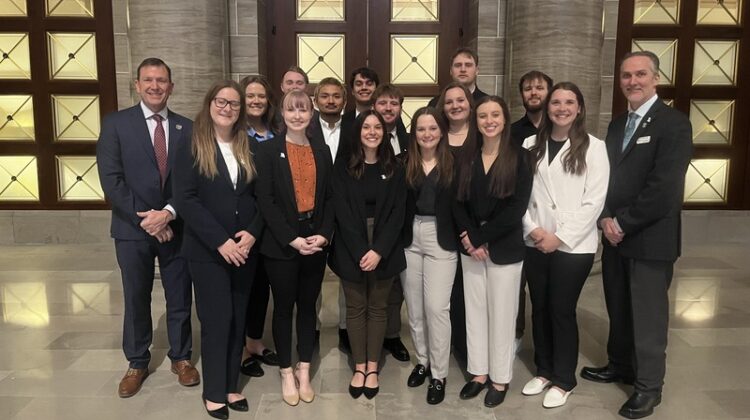
Athletic training students with Dr. Richard Biff Williams (far left) and Dr. W. David Carr (far right) at the Missouri Capitol.

For many students, advocacy may seem distant and reserved for professionals, but Missouri State University students are learning to make their voices heard — in class and at the state Capitol. 

Two recent events gave social work and athletic training students a chance to engage with Missouri’s legislative process.  

A big day for social work students 

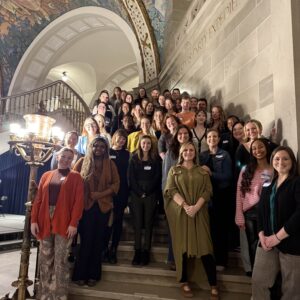
Social work students and faculty members at the Capitol
Social work students and faculty members at the Capitol.

On March 4, around 50 social work students attended the Behavioral Health Professions Rally at the Missouri State Capitol in Jefferson City. During the event, they heard inspiring messages from Rep. Aaron Crossley and Rep. Melanie Stinnett.

Students got to sit in both the House and Senate sessions. They watched lawmakers in action during the legislative process.   

“We want students to see that their voice matters,” said Salina Bollinger, clinical assistant professor in the School of Mental Health and Behavioral Sciences. “We want them to leave knowing they can make a difference.” 

Besides Bollinger, three other faculty members, Natalie Curry, Stacy Johnson and Heather Eckhart  supported the students at the Capitol.   

The faculty encouraged students to choose issues they care about, such as mental health and child safety. Since many of the students are involved in practicum placements, they understand the real needs of the people they serve. 

“This was my third time attending and each year brings something new and powerful,” said Victoria Kleene, a social work graduate student. “It’s inspiring to see advocacy in action and understand how our classroom learning can drive real policy change.” 

For Kersten Shuler, also a social work graduate student, asking questions and hearing directly from lawmakers helped her better understand how the legislative process really works. 

“The experience was empowering, and it sparked a deeper interest in advocacy,” she said. 

A surprise moment on the Senate floor

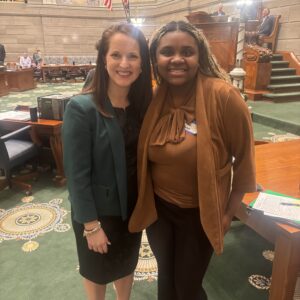
Senator Maggie Nurrenbern (left) and Ketsia John (right)
Sen. Maggie Nurrenbern (left) and Ketsia John (right).

One special moment stood out during the visit. Sen. Maggie Nurrenbern introduced Ketsia John, a Bachelor of Social Work student and Social Work Club president, to the Senate. 

The moment was even more meaningful because of their past connection. Nurrenbern was once John’s high school teacher in Kansas City.  

The recognition reminded everyone in the room that advocacy often begins with relationships and a strong sense of community. 

Athletic training students get their turn 

On March 5, 15 Master of Athletic Training students participated in the advocacy day for health care-related issues.  

Dr. W. David Carr, professor in the School of Health Care Professions, and Dr. Michael Hudson, professor in sports medicine and athletic training, led this event. Both encouraged students to focus on relationship building rather than pushing for new legislation.  

“This visit was about gratitude and connection with lawmakers who support our profession,” said Carr. “We wanted students to see how advocacy works, not just by asking for change, but by showing appreciation.” 

The group also had the opportunity to speak with university President Dr. Richard Biff Williams, who was at the Capitol for the university and to show support for athletic training (he is an athletic trainer). 

Students met with six lawmakers who supported bills related to school safety and athletic health. They thanked each legislator and handed them a “Friend of Athletic Training” certificate in appreciation. 

“Talking to legislators helped me see how policies directly impact what we do,” said graduate student Kate Forward. “It reminded me we’re not just practitioners; we’re part of the larger conversation in our field.” 

Why advocacy matters

To prepare for the Capitol visit, social work students joined online sessions with National Association of Social Workers resources. Athletic training students received guidance in class and reviewed materials from the Missouri Athletic Trainer’s Association.  

“This experience helps students overcome fear and step into advocacy with confidence,” said Bollinger. “It helps them see that advocacy is part of their professional responsibility.” 

Both programs plan to continue these annual advocacy events for students to find their voice and lead change. 

“Students gain more than knowledge; they gain courage,” Carr said. “This is how leadership begins.” 

Explore degree options in MCHHS

Filed Under: MCHHS News Tagged With: Athletic training, David Carr, Michael Hudson, Salina Bollinger, School of Health Care Professions, School of Mental Health and Behavioral Sciences, Student Success, students

« Previous Page
Next Page »

Categories

Archives

Meta

  • Log in
  • Entries feed
  • Comments feed
  • WordPress.org
  • Accessibility
  • Disclaimer
  • Disclosures
  • Equal Opportunity Employer and Institution
  • © 2026 Board of Governors, Missouri State University
  • Contact Information

Loading Comments...