Missouri State University

Skip to content Skip to navigation
a b c d e f g h i j k l m n o p q r s t u v w x y z

College of Education News

Giving teachers input on rural school policy

September 23, 2021 by Strategic Communication

The Rural Imperative Initiative aims to give a voice to rural schools across the nation. Missouri State University is partnering in this effort to bring the needs and concerns of rural schools to the attention of state, regional and national policymakers.  

The initiative is a collaborative effort between Rural Schools Collaborative (RSC), National Rural Education Association (NREA) and Community Foundation of the Ozarks (CFO). The initiative is funded by the Bill and Melinda Gates Foundation. 

The Rural Imperative Initiative will help teacher-leaders connect policy to place in five rural regions: Appalachia, Black Belt, Borderlands, Rust Belt and Northern California. 

The College of Education (COE) at Missouri State University is spearheading the rural school initiative program for the Rust Belt region.  

“We’ll be working with school partners to identify teachers to participate in this initiative,” COE Interim Dean Barri Tinkler said. “The COE is very excited to be a part of this work to engage teacher’s voices in contributing to policy formation.” 

Each of the five regions will create their own rural-teacher caucus. These groups will work together to create a “policy playbook” of local recommendations based on the specific challenges and opportunities in their area. 

Each partner organization receives $10,000 in funding to support their regional teacher caucus. 

Other regional partners include:  

  • Borderlands region: Arizona Rural Schools Association 
  • Appalachia region:  The University of Tennessee – Chattanooga 
  • Black Belt region: The University of West Alabama 
  • Northern California region: North State Together

“Advocating for rural education has been a long-standing priority for each of these organizations,” RSC Executive Director Taylor McCabe-Juhnke said. “We are honored to work with such high caliber partners to create a meaningful platform for teacher advocacy.” 

Over the coming school year, the policy playbook partnership will support these five partners in exploring the opportunities and challenges faced by teachers in their region. RSC, in partnership with the NREA, will then compile these recommendations and advocacy guidelines into a useful resource to benefit teachers and policymakers everywhere. 
Filed Under: COE Faculty, Uncategorized Tagged With: education

Filling in the gaps of technology education in our community

July 26, 2021 by Strategic Communication

With technology becoming a vital part of our day-to-day lives, it is easy to take basic tech skills for granted.  

Earlier this year, students in Missouri State University’s College of Business identified the need for basic technology skills and access for women who were recently out of situations of domestic abuse.  

Now, Annice McLean and Dr. Ching-wen Chang, faculty in Missouri State’s department of reading, foundations and technology (RFT) in the College of Education, are volunteering their time to help women gain the skills they need to get back on their feet.  

Acknowledging a need 

The project began as an assignment for MGT 440, leadership and development skills: identify a need in the community and offer a solution.  

The students focused their problem-solving skills on safe houses, or places women find shelter and support after leaving a domestic abuse situation.  

“What this project determined is that there was a gap in access to and use of technology,” McLean said. “This can be a hindrance to women finding gainful employment and pursuing further education.”  

Finding volunteers 

Van Oswald, one of the students on the project, reached out to the RFT department, hoping they could volunteer their time to provide technology education to women in need.   

McLean and Chang were some of the first faculty members who became aware of this project.  

As they met with the safe house coordinator, they realized the necessity to limit the number of people involved to maintain confidentiality for the women in the safe house.  

“We were excited about it and thought it was definitely a need. So, we volunteered to be part of the project,” McLean said.  

A unique curriculum 

The course that McLean and Chang are offering to the women is different from your typical introductory computer course.  

“The goal was to design a course that meets the needs and goals of individuals,” McLean said. 

The two teachers started with a list of basic information they thought would be relevant to anyone new to computers.  

As they began meeting, they gained a better understanding of the specific needs of each woman.  

“It could be anything from email, how to do a Zoom meeting, how to online shop or lessons on security,” McLean said. “It could even be about using online games to help reduce stress or accessing homework sites to help kids with online learning.”  

The best thing they could do was create a flexible plan that could help each woman reach her goals.  

“They just want something relevant to them – they need to find a job, finish school or manage their online banking,” Chang said. “So, we change the curriculum to help them do what they want to do.”  

Teaching and learning  

McLean and Chang use technology quite frequently in their work, but they could still relate with the struggle of learning new technology. “I think back to the first time I was going to have a Zoom meeting,” McLean said. “I was fearful it wasn’t going to work.”  

Having worked with the women several times throughout the semester, McLean and Chang felt everyone took something away from the lessons.  

“I felt like we helped the ladies. I also felt like I gained something from them as well – an appreciation of their attitudes and positivity,” McLean said.  

Inspiring awareness  

McLean and Chang hope that what they have started won’t end here.  

“I think our ultimate goal is to make it more seamless for the ladies – more convenient for them and their schedules,” McLean said. 

In the future, they hope to be able to provide more permanent access to computers and the internet. So far, they have been borrowing Chromebooks from the university for each session.  

“When we finish the class, we leave with the Chromebooks,” Chang said. “But hopefully, if this goes on, we may be able to work on a grant to buy some.” 

They also hope that their work will bring more awareness to others who may be struggling with access to technology or technological skills.  

“Maybe if other people hear about this, they will contact us, and we could set up some other opportunities for something similar,” McLean said. 

Contact Dr. Ching-wen Chang for more information.    

Contact Annice McLean for more information.   

Filed Under: Uncategorized Tagged With: education

Ungrading: shifting the classroom focus back to learning

June 4, 2021 by Strategic Communication

“If my curriculum and pedagogy aren’t sufficiently engaging, is that an argument to rely on grades to coerce students into doing what I want?” 

This is a quote from Alfie Kohn’s foreword to “UNgrading: Why Rating Students Undermines Learning (and What to Do Instead).”  

The book inspired Dr. Chloe Bolyard, assistant professor in Missouri State University’s department of childhood education and family studies (CEFS).  

Now Bolyard is looking for ways to take the emphasis off grades in her classroom.  

She first heard about the topic of ungrading through interactions on Twitter between various education professionals.  

Ungrading is a classroom philosophy that emphasizes feedback rather than scores or letter grades.  

“We all define it differently, but I think the goal is the same,” Bolyard said. “It’s a focus on learning.” 

What ungrading looks like  

When Bolyard adopted this new philosophy, she had to decide what specific things she would need to change in her classroom to align with ungrading. 

“You can’t just get rid of letter grades and say that you’re ungrading,” Bolyard said. “It carries over into all of the decisions you make as a teacher.”  

This spring was Bolyard’s first semester implementing ungrading.  

Some noticeable changes in her methodology:  

  • Shifting from scores and rubrics to narrative feedback. 
  • Creating flexible deadlines or “best by” dates.  
  • Having students self-assess and reflect on their learning throughout the semester. 
  • Asking students to suggest their grade at the mid-point and end of the semester. 

“My whole goal with ungrading, aside from focusing on learning, is to make my work with students more humanizing,” Bolyard said. 

Rewards of ungrading  

A big part of ungrading for Bolyard has been considering what she can do to acknowledge her students’ humanity.  

“My students are humans. They’re not just students in my class. They have other classes, and they have life beyond Blackboard,” Bolyard said.  

“Humanizing is recognizing that these students are doing a whole lot. The semester is full of unknowns in terms of their health, their family members’ health, their schedule, their mental wellbeing.” 

Already, Bolyard has received feedback from her students about how functional ungrading has been for them.  

“Students have commented about appreciating the flexibility,” Bolyard said. “They don’t need to apologize to me for turning in things that they perceive as late.”   

“One student has been really vocal about how it has helped her to learn so much, and to push herself to take more creative risks,” Bolyard said.   

Challenges of ungrading  

Ungrading is not an easier version of traditional classroom grading. There are many challenges to face when adopting a philosophy that goes against the status quo.  

“Part of the ungrading conversation is figuring out how the teacher navigates institutional requirements to still submit a final grade,” Bolyard said. “Some folks who’ve adopted ungrading may still use grades but use fewer grades. Or assignments might be worth fewer points.”  

Another challenge is how to set clear expectations while giving students more creative freedom.  

“Students don’t like ambiguity when it comes to a teacher’s expectations,” Bolyard said.  

Self-assessment is one of the most important aspects of ungrading. In Bolyard’s classes this semester, students are using self-assessments and determining their own grade.  

“I had a student tell me that she doesn’t know how to grade herself or evaluate herself. That’s another reason why we need to do this,” Bolyard said. “If students can’t evaluate how they’re doing for themselves, I think that’s problematic.”   

Another challenge is the different workload that ungrading requires.  

“It’s way more work intensive for me. It takes longer to leave narrative feedback than to check boxes on a rubric,” Bolyard said.  

Getting started with ungrading 

Ungrading, as a classroom philosophy, is still an emerging conversation. Bolyard just wrapped up her first semester using it in her classroom, and she admits there is still a lot for her to discover. 

“I’m going to spend a lot of time this summer reflecting on what I think went well and looking at student feedback from the end of the semester,” Bolyard said.  

 She also acknowledges that she has a lot of freedom in her position to be able to try different approaches to student evaluation.  

“I have a lot of privilege in my position in higher ed to say yes to ungrading,” Bolyard said. “I recognize for other people, depending on a number of factors, that it might be something they need to more carefully consider.” 

The challenges for getting started with ungrading may look different depending on each person’s situation, so she offers some advice for educators who are interested in using ungrading in their classroom.  

“Read as much as you can, talk to other people who are doing it, and find a community who can support you,” Bolyard said. “Don’t feel like you have to completely toss grades out from every assignment. Maybe you just choose a couple of assignments, and you see what happens when you don’t use grades on those assignments.”   

Join the conversation. Read about #Ungrading on Twitter.   

Filed Under: Uncategorized Tagged With: childhood education and family studies, education

College of Education alumni recognized as outstanding beginning teachers

April 8, 2021 by Strategic Communication

Kaitlin Voss teaches at the front of her classroom at the Kansas School for the Deaf.

Being a beginner at anything can be difficult. For beginners Kaitlin Voss and Marcus Bullard, alumni of Missouri State’s education program, there was no shortage of difficulties as they began their teaching careers.  

Their hard work to overcome the many challenges they face as teachers is not going unnoticed. Bullard and Voss have both been recognized as Missouri Association of Colleges for Teacher Education (MACTE) 2021 Outstanding Beginning Teachers. 

Voss graduated in 2019 with her bachelor’s in education of the deaf and hard of hearing and in 2020 with her master’s in the education of deaf and hard of hearing. She is currently a third-grade teacher at the Kansas School for the Deaf.  

Bullard graduated in 2019 with his bachelor’s in elementary education and in 2020 with his master’s in educational technology. He is currently a second-grade teacher at Westport Elementary.  

Q&A with outstanding beginning teachers 

Both teachers shared details about their careers, offered helpful advice for the classroom and relayed pleasant memories from their time at Missouri State:  

What was the most challenging aspect as you began teaching?  

Voss: Figuring out what works best for each of my students is definitely the biggest challenge. And, of course, COVID has been an added struggle, but if I can get that done in my first year, then I guess the rest will be a breeze. 

Bullard: Navigating through a new school, learning things about curriculum, managing student conflict and helping students have productive conversations with each other were probably my biggest challenges. Coming from MSU, I felt prepared with being creative, and I had strategies that I could use. In your first year of teaching, you learn a whole different set of strategies. Going into a school, you kind of have an idea of how the school works, but you don’t truly know the culture of the school or how the students function day to day.  

How were you able to overcome those challenges as a new teacher?  

Voss: Talking with other teachers. Thankfully, I have such a great support system – teachers, my principal – they’re all amazing. Also, I ask my kids. I honestly rely on them because they know themselves. Having them as an active participant in trying to figure everything out definitely helps.   

Bullard: Last year I was in a team of four teachers teaching in the second grade. Having them as a support system was a huge deal for me. I learned  that it’s okay to lean on other people. You’re not in this teaching world alone. So, seeing all these positive role models influenced my own teaching. 

What are some of the most rewarding aspects of being a teacher?  

Voss: Just seeing their faces – like when we came back from spring break – and seeing those lightbulb moments and the little connections that they make is so rewarding. It makes the challenges all worth it.   

Bullard: The most rewarding thing is being able to be a positive role model for my kids.  

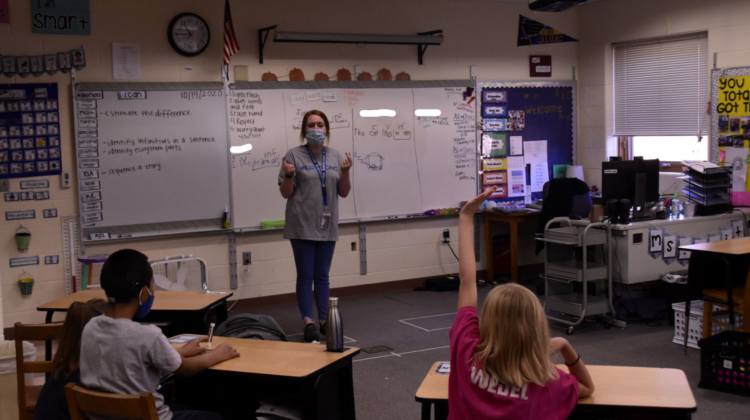
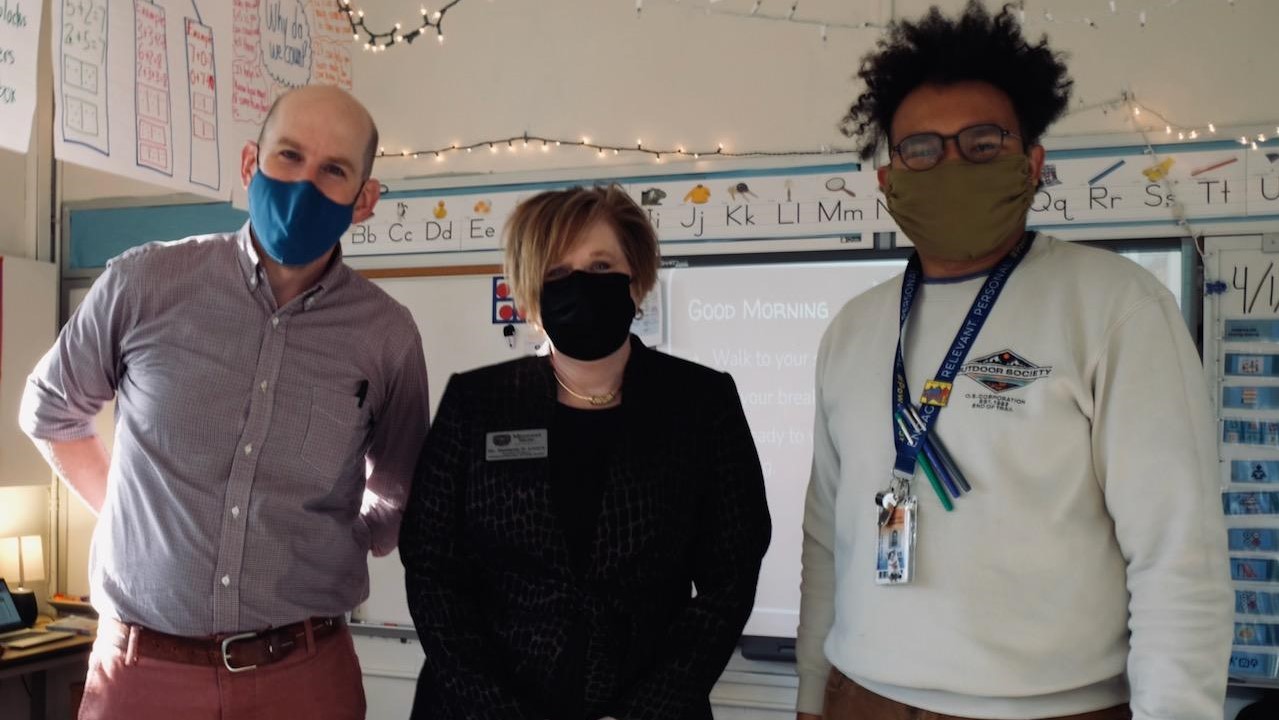
Elementary Program Coordinator, Dr. Stefanie Livers and Dr. Minor Baker make a congratulatory visit to Mr. Marcus Bullard in his classroom at Westport K-8 school

What is one thing that you learned while at MSU that has paid off to know as you began your career in education?  

Voss: MSU did a great job of readying me for this diverse group of students with skills like utilizing your visuals, acting things out and making it as engaging as possible. Also, we have a preschool at Missouri State in Ann Kampeter Health Sciences Hall. That was probably my favorite experience, just to be able to have that connection right there: you sit in class, you learn and then you walk downstairs, and you get to apply it to real life. 

Bullard: My focus was educational technology for my graduate degree, so having a background in how to facilitate learning online was definitely a big help. With COVID, it was scary because we didn’t know when we were going to see our kids again or how we were going to be effective teachers. If I didn’t have those classes, I wouldn’t have been able to be successful with virtual learning. 

What is one of your favorite memories from your time at Missouri State?  

Voss: Being able to see the deaf community in action was probably the coolest experience – just going to the mall for a chat or to a coffee shop to hang out. We also had a big picnic together with people who are deaf and hard of hearing in Springfield and surrounding areas – one in the fall and one in the spring. So, yeah, MSU was the greatest experience I could have ever asked for in a college, and not just in my program, but in the Springfield community.  

Bullard: One of my favorite memories was the first night – meeting people that I know will probably be in the rest of my life. I lived in a Living Learning Community (LLC) and there was a night at the rec center where LLC students could mix and mingle. Without MSU, I wouldn’t have the little close-knit group of friends that I have. I’m in Springfield and they’re in St. Louis and we still talk every day.   

Filed Under: COE Alumni Tagged With: alumni, award, education

Cheating in the time of COVID-19: An ongoing study

April 7, 2021 by Strategic Communication

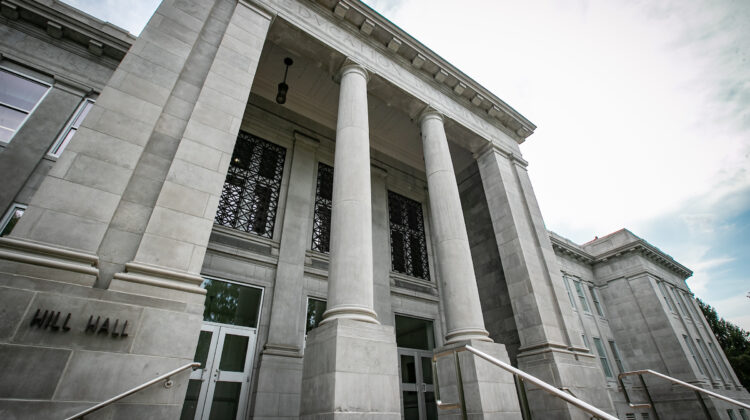
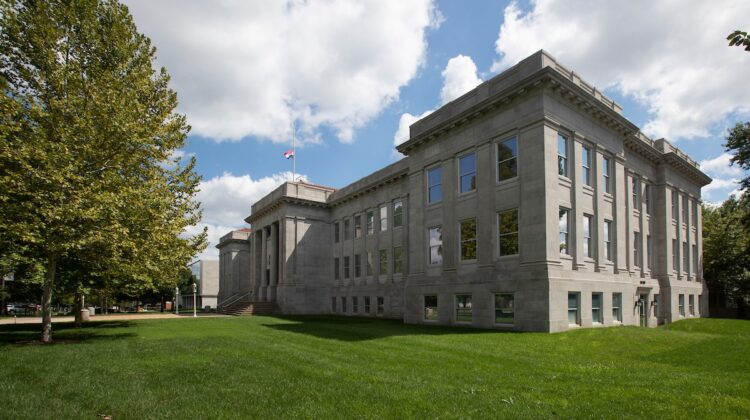
The front of Hill Hall on Missouri State's campus.

Are my students cheating? 

That question looms over every teacher. With the shift to virtual learning due to the pandemic, some questioned if there was a way to prevent cheating at all. 

Professors at Missouri State, Marshall and Kansas State universities are examining the issue of cheating, specifically, whether the conditions of the pandemic caused an uptick in academic dishonesty.  

The original study  

Eleven years ago, while working at Marshall University, Dr. James Sottile, professor in MSU’s counseling, leadership and special education (CLSE) department, conducted research to determine if college students were cheating. Then, he compared cheating in seated courses to that of online classes.  

The results of the 2010 study showed that while some students were cheating, there was not a significant difference between the likelihood of cheating in person versus online.  

“Everybody assumed people would cheat more online, but that wasn’t the case,” Sottile said. “If people are given the opportunity to cheat, they’re going to cheat. That’s pretty similar for being online or face to face.” 

Data during the pandemic  

Considering the changes in class delivery during the pandemic, Sottile, along with Dr. Bonni Behrend, also a professor in the CLSE department, embarked on a follow-up cheating study.  

Not only did the pandemic present an interesting environment, but technological advancements over the past decade were also factors to consider.  

“Classes that were traditionally brick and mortar now have this virtual component,” Behrend said. “When you’re forced into a virtual setting, you maybe don’t have the time or the capabilities to think outside the box about what students could be doing whenever you’re giving them a test.” 

Sottile and his colleagues collected data through a survey like the one used in the original study. They added additional questions to gauge if students were more likely to cheat since the pandemic began. 

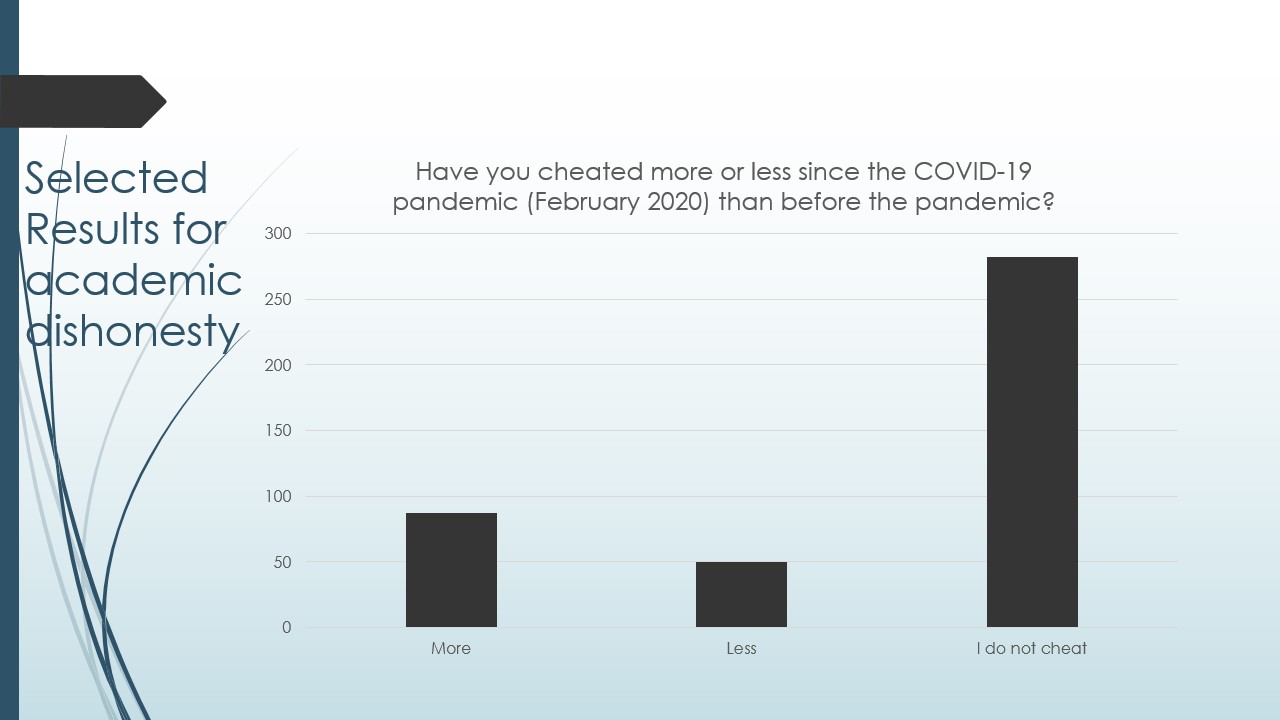
Survey results from 698 college student participants show that students may have cheated more during the pandemic.  

Survey results to the question: Have you cheated more or less since the COVID-19 pandemic (February 2020) than before the pandemic?

Sottile, Behrend and their co-researchers will return to the study for a third time with more specific questions including:  

  • What percent of students in your live classes do you believe cheat at least once during the semester? 
  • What percent of students in your online classes do you believe cheat at least once during the semester? 

They hope to narrow down their results to the most accurate depiction of what has happened during the pandemic.  

“It needs to be also stated that a lot of people said they don’t cheat at all, and that’s good,” Behrend said. “But I think as we get more sophisticated with technology, our curriculum and the ways that we deliver education, we have to anticipate the needs.” 

Addressing the issue of cheating 

According to major psychological theorists, people who cheat are often motivated by how cheating will benefit them.  

When it comes to academics, Sottile explained that the more competitive the atmosphere is, the higher the rates of cheating tend to be.  

For example, the original research showed that:  

  • Graduate students tend to cheat slightly more than undergraduate students. 
  • Athletes tend to cheat slightly more than non-athletes.  
  • Men tend to cheat slightly more than women. 

However, Sottile and his colleagues proposed that the solution is not to remove the competitive element. Rather, they would like to raise the moral standards students are held to in academics.  

“The way you increase a person’s moral development, which is backed up by research, is to provide them with ‘what if’ scenarios and codes of ethics,” Sottile said.  

Academic integrity at Missouri State  

Sottile affirmed academic integrity policies in place at Missouri State are adequate if they are supported by teachers and administrators.  

“I think everyone needs to be more aware of what we can do to prevent people from cheating, or decreasing the chances of cheating, as well as increasing a person’s moral development,” Sottile said.  

Behrend notes the purpose of conducting research on topics like this is not to highlight the negative, but to acknowledge that there is room for improvement.  

“People are going to cheat to meet a need,” Behrend explained. “We have to think about what we can do on the backside to be proactive about it as educators, as people who are educating the next leaders. At Missouri State, we talk about the public affairs mission in that way – how it helps to create greater thinkers.” 

MSU academic integrity policies   

Academic integrity resources for students  

Filed Under: COE Faculty Tagged With: counseling leadership and special education, COVID-19, education, research

« Previous Page
Next Page »

Categories

  • Bear POWER
  • Child Life Studies
  • COE Alumni
  • COE Faculty
  • COE Staff
  • COE Students
  • Counseling
  • Early Childhood and Family Development
  • Educational Administration
  • Elementary Education
  • Graduate Program
  • Literacy
  • Middle School Education
  • Secondary Education
  • Special Education
  • Student Affairs
  • Uncategorized

Archives

Meta

  • Log in
  • Entries feed
  • Comments feed
  • WordPress.org
  • Accessibility
  • Disclaimer
  • Disclosures
  • Equal Opportunity Employer and Institution
  • © 2026 Board of Governors, Missouri State University
  • Contact Information